
How many ketamine treatments for anxiety you need depends on how you respond, but most clinics start with a series of 4 to 6 sessions over 2 to 4 weeks. After that, your provider reviews your progress. Some people stop after the first series, while others return for booster sessions.
At Placid Psychiatry in Fullerton, CA, many patients ask this question after 2 or more anxiety medicines have not given enough relief. This guide covers what research shows, how a typical ketamine plan runs, what Spravato treatment looks like at our clinic, and what happens at each step.
Why Do Most Ketamine Plans Start With 4 to 6 Sessions?
Most ketamine plans start with 4 to 6 sessions because early research on repeated infusions used about 6, while real-world patients often need fewer. This number is a starting point, not a fixed rule. Your provider adjusts it based on how your anxiety responds during the series.
 Where the Six-Session Model Came From
 Where the Six-Session Model Came From
The 6-session model comes from depression research, not anxiety research. A 2010 pilot study at Mount Sinai first gave 6 IV ketamine infusions to people with treatment-resistant depression. A 2013 Biological Psychiatry trial led by James Murrough then gave up to 6 infusions to 24 people, 3 times a week over 12 days. For anxiety, researchers have not yet agreed on the best number of sessions.
Results With Fewer Sessions
Real patients often need fewer visits than the 6-session model suggests. In a 2022 BMC Psychiatry study of 452 outpatients led by Sachin Ahuja, patients had a median of 4 intramuscular (IM) ketamine treatments, with a range of 1 to 48. Most patients had depression, and about half also had generalized anxiety disorder. This means half of the patients had 4 treatments or fewer.
When Progress Is Only Partial
Some people feel a little better by the end of the series but not as well as they hoped. In this case, your provider may raise the dose slightly, change the spacing of sessions, or add a few visits to see if the response grows stronger.
Why Do Ketamine Protocols Differ Between Clinics?
Ketamine protocols differ because no trial has set a standard number of sessions for anxiety. Ketamine is mostly studied in people with treatment-resistant anxiety, a varied group, so clinics adjust their plans rather than follow one strict formula.
The research is also small and mixed. A 2022 systematic review led by Jamie Tully of the University of Exeter, published in the British Journal of Clinical Pharmacology, found that ketamine’s anxiety relief was often temporary. Without one agreed method, each clinic builds its ketamine treatment schedule from the evidence and its own experience.
Ketamine Treatment Schedule for Anxiety
The initial series, often called the induction phase, usually runs over 2 to 4 weeks. Ketamine infusions for anxiety are often given 2 to 3 times a week, while IM ketamine and nasal spray programs may use 1 or 2 visits a week. Sessions stay close together at the start so the effects can build on each other.
Partway through the series, often after the 3rd or 4th visit, your provider checks how you are responding. A final review comes at the end of the series. At that point, you may stop and watch your symptoms, move to occasional booster visits, or talk about other options if the response was weak.
A Sample First-Month Ketamine Treatment Schedule
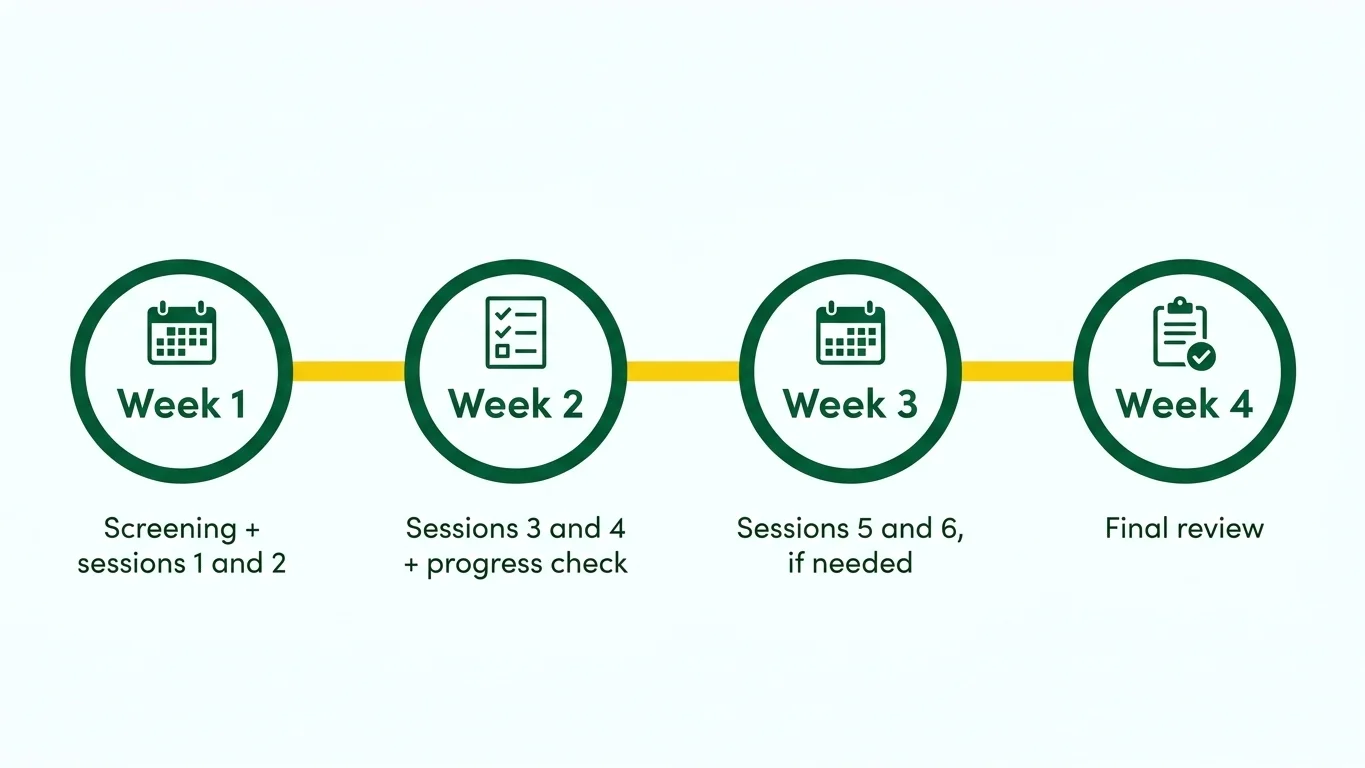
- Week 1: Screening visit, then sessions 1 and 2.
- Week 2: Sessions 3 and 4, plus a progress check and GAD-7 review.
- Week 3: Sessions 5 and 6, if needed.
- Week 4: Final review. You stop and monitor, schedule boosters, or discuss other options.
How Soon Does Ketamine Start Helping Anxiety?
Ketamine often works faster than standard anxiety medicines. Selective serotonin reuptake inhibitors (SSRIs), the most common anxiety medicines, usually take 4 to 6 weeks to reach their full effect. That speed is a major reason people with stubborn anxiety consider ketamine. Still, the timing differs from person to person.
Relief After the First Ketamine Session
Some people notice a change within hours of their first visit. In a 2017 study led by Paul Glue at the University of Otago in New Zealand, published in the Journal of Psychopharmacology, 12 patients with hard-to-treat generalized or social anxiety received weekly ketamine injections under the skin. They reported less anxiety within 1 hour, the relief lasted up to 7 days, and 10 of the 12 responded at the higher doses.
How Soon Most People Notice a Difference
Not everyone feels a change after the first visit. In the 2013 Mount Sinai trial, how a person felt 4 hours after the first infusion strongly predicted their response at the end of the series. A slower start does not always mean the treatment is failing. In a 2019 American Journal of Psychiatry trial, some people who did not respond to a single ketamine infusion went on to respond over a course of repeated infusions. Early signs of improvement include falling asleep more easily, worrying less during the day, and staying calm in meetings or crowds that used to trigger anxiety.
How Long Do Ketamine Benefits Last for Anxiety?
How long relief lasts depends on how many sessions you have and whether you get follow-up care. Research points to a clear pattern: more structured treatment usually means longer-lasting results.
Relief After a Full Series
After a complete series, relief often lasts weeks, and some people stay well for months. In the 2013 Mount Sinai depression trial, relief lasted a median of 18 days after the last infusion. In the 2022 BMC Psychiatry study, patients on maintenance treatment kept their gains for more than 7 months.
Why Anxiety Symptoms Can Return
Ketamine eases anxiety, but it does not cure it. A 2025 systematic review of 78 studies by Vasilios Masdrakis and colleagues in the Journal of Psychopharmacology found that ketamine and esketamine were linked to lower anxiety. The same review found that anxiety may return after treatment stops.
The Role of Repeated Treatment in Lasting Results
Ongoing sessions can help protect your progress. A 2021 meta-analysis by Elizabeth Whittaker, Paul Glue, and colleagues in Therapeutic Advances in Psychopharmacology found that ketamine eased anxiety in 4 of 6 controlled trials. Smaller open-label studies linked ketamine maintenance for anxiety to longer relief and better social and work functioning.
Ketamine Booster Treatment and Ketamine Maintenance for Anxiety
Some people stay well after their first series and never need more sessions. Others find their symptoms creeping back and need extra visits. Ketamine maintenance for anxiety is shaped around your needs, not a fixed calendar.
What a Ketamine Booster Treatment Means
A ketamine booster treatment is a single session given after the initial series ends. Its purpose is not to start over but to top up the benefits you have already gained.
How Providers Plan Booster Timing
Your provider watches how quickly your anxiety returns after the series. If relief tends to fade after about 3 weeks, a booster near that point may help. In a real-world maintenance study of people with treatment-resistant depression, published in the Journal of Clinical Psychiatry, patients started with weekly treatments. Those who stayed well stretched the gap to every 2, 3, and 4 weeks, then every 5 to 6 weeks. If symptoms returned, sessions moved closer together again.
Long-Term Ketamine Treatment Is Not for Everyone
Long-term ketamine is not the goal for most people. Many use it as a bridge, easing symptoms while other treatments have time to work. Your provider reviews whether you still need boosters at each follow-up visit.
Personal Factors That Shape Your Treatment Plan
Your own situation plays a large role in how many ketamine treatments for anxiety you will need. Generalized anxiety, social anxiety, panic, and PTSD can respond differently, and long-lasting symptoms or many failed treatments often mean a longer series. Living with depression can also change your dose and goals.
How your body reacts counts too. A strong change after the first 2 or 3 sessions often means fewer visits overall. The way you receive ketamine, and how you handle side effects like dizziness or nausea, can change your dose and how often you come in. Your provider reviews these factors at your first visit and again at the end of the first series.
Who Qualifies for Ketamine Treatment for Anxiety?
Adults with treatment-resistant anxiety usually qualify for ketamine treatment. Treatment-resistant anxiety means symptoms did not improve after 2 or more adequate trials of standard care, such as SSRIs, SNRIs, or cognitive behavioral therapy (CBT). A psychiatrist confirms eligibility through a full psychiatric evaluation before the first ketamine session.
If several treatments have not worked for you, that does not mean your anxiety cannot improve. It means a different approach may be worth exploring.
Indications for Ketamine Treatment
Ketamine treatment may be appropriate for adults with treatment-resistant generalized anxiety disorder (GAD), social anxiety disorder, or PTSD. It may also help adults whose anxiety occurs alongside treatment-resistant depression. Your blood pressure and heart health also need to be stable before treatment begins.
Contraindications for Ketamine Treatment
Ketamine treatment may not be safe for people with:
- Uncontrolled hypertension or significant cardiovascular disease
- A history of psychosis or schizophrenia
- An active substance use disorder
- Pregnancy
Why Screening Comes First
A 2017 consensus statement from an American Psychiatric Association task force, published in JAMA Psychiatry, urged careful screening before off-label ketamine use. Your psychiatrist reviews your cardiovascular health, psychiatric history, and substance use history before your first session. If ketamine is not the right fit, your psychiatrist will talk with you about other treatment options.
Ketamine Infusions for Anxiety vs Other Forms of Ketamine
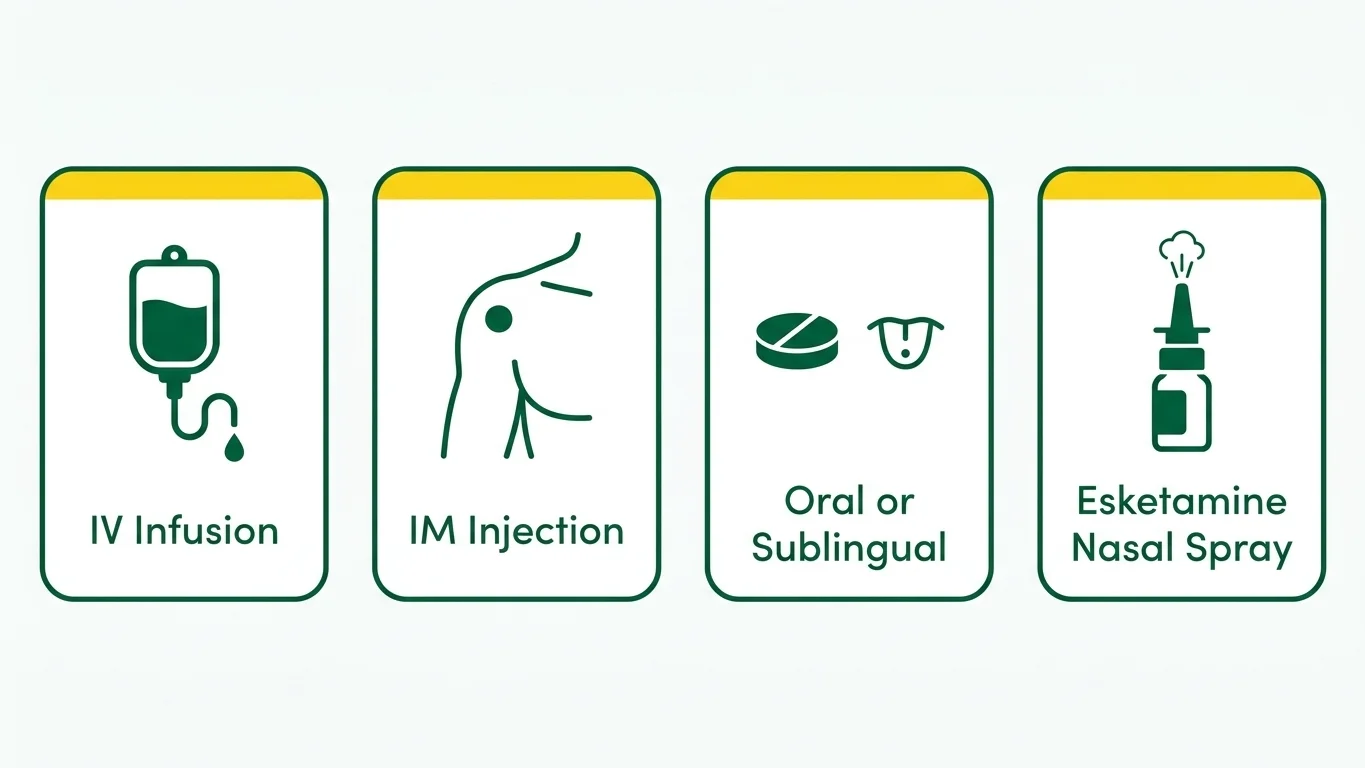
Ketamine can be given in more than one way, and each form has its own schedule.
| Feature | IV Ketamine Infusion | Intramuscular (IM) Ketamine | Oral or Sublingual Ketamine | Esketamine Nasal Spray (Spravato) |
| How it is given | Through a vein over about 40 minutes | Shot into a muscle | Tablet or dissolving lozenge | Spray in the nose |
| Typical starting series | About 6 sessions over 2 to 3 weeks | About 4 to 6 sessions over 2 to 4 weeks | Varies by provider | 2 times a week for 4 weeks |
| Where it is given | Clinic with monitoring | Clinic with monitoring | Sometimes at home with remote check-ins | Certified clinic only (Spravato REMS program) |
| FDA status | Off-label for anxiety | Off-label for anxiety | Off-label for anxiety | Approved for certain types of depression, not anxiety |
| Main benefit | Fast, exact dosing | No IV line needed | More convenient | FDA-approved product with insurance options |
Sources: Spravato prescribing information, Janssen, 2025; IV schedule from Murrough et al., 2013.
How Much Does a Ketamine Series for Anxiety Cost?
Ketamine for anxiety is usually self-pay because it is used off-label, so most insurance plans do not cover it. IV ketamine infusions average about $450 per session, with most clinics charging $300 to $800, so a 6-session series often costs about $1,800 to $4,800. IM ketamine averages about $350 per session, with most clinics charging $200 to $500. Booster sessions usually cost the same as a single session in the starting series.
Spravato (esketamine) costs about $750 per session before insurance, but it is often covered when prescribed for approved types of depression. Ask for a written cost estimate at your first visit, and check with your insurer about Spravato coverage before you start.
How Spravato Treatment Works at Placid Psychiatry
Placid Psychiatry in Fullerton, CA, offers Spravato (esketamine) nasal spray. Spravato is FDA-approved for adults with treatment-resistant depression, and for depressive symptoms in adults with major depressive disorder who have suicidal thoughts or behavior. It is not approved for anxiety alone. Many people with depression also live with anxiety, so our psychiatrists track anxiety symptoms alongside depression during treatment.
Spravato follows a set schedule for treatment-resistant depression. You come in 2 times a week for weeks 1 to 4, then once a week for weeks 5 to 8. After that, sessions continue once a week or every 2 weeks, using the fewest sessions that keep you well. This adds up to about 12 sessions in the first 8 weeks.
Each visit takes about 2 hours, because staff must monitor you for at least 2 hours after each dose under the Spravato REMS safety program. Because Spravato is FDA-approved, many insurance plans cover it when you meet their criteria.
What to Expect During a Ketamine Session
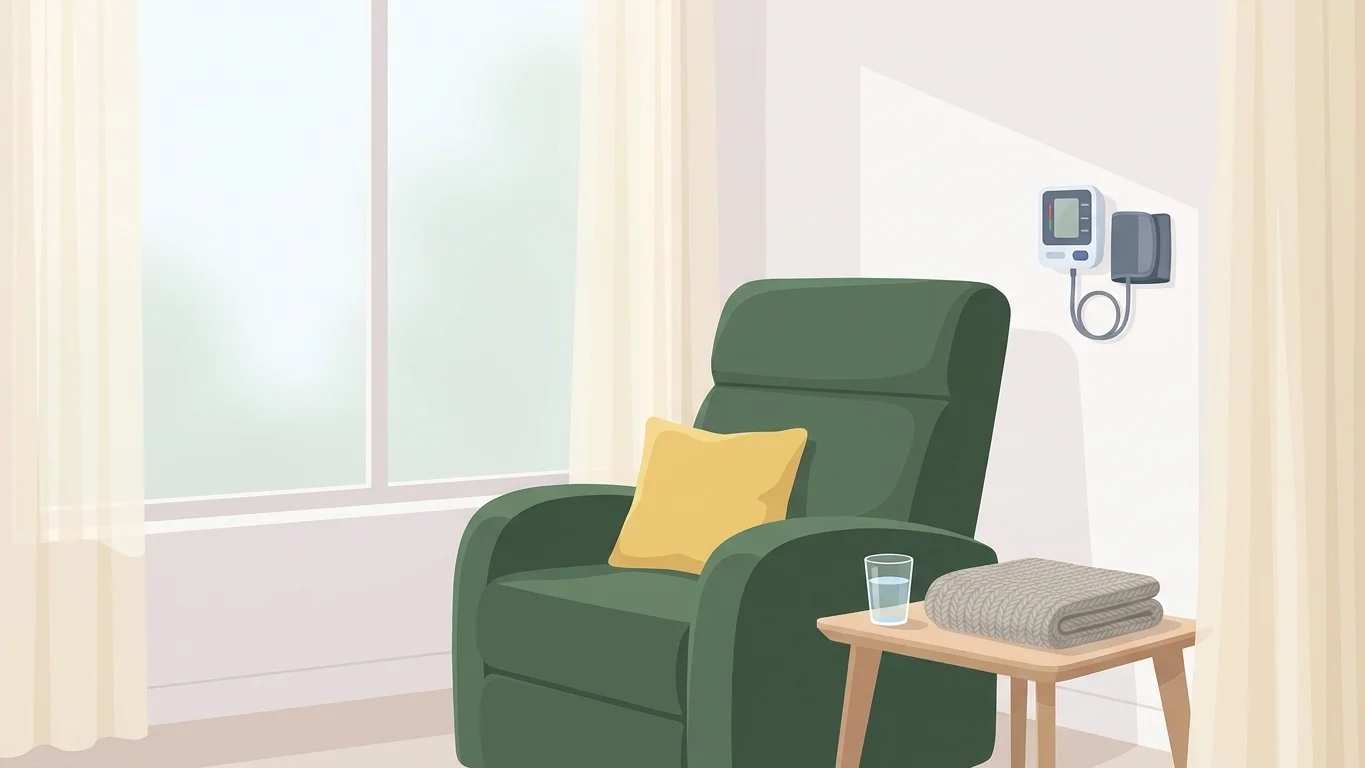
A ketamine session follows the same steps each time. Before treatment begins, your provider reviews your health history, medicines, and blood pressure, and you may be asked not to eat solid food for about 6 hours, though clear liquids are usually fine up to 2 hours before. During the session, you rest in a quiet room. Many people feel relaxed, floaty, or a bit detached, and these feelings usually fade within 1 to 2 hours.
After the treatment, you stay until staff confirm you are stable. You cannot drive for the rest of the day, so plan a ride home. Ketamine can raise blood pressure and heart rate for a short time, so staff check these signs during and after each session to keep you safe. Most visits last 1.5 to 3 hours in total, including a recovery period of 20 to 45 minutes.
Measuring Your Response to Ketamine
Providers use more than one sign to judge your progress. Before each visit, you will usually fill out a short form like the GAD-7, and lower scores over time show that your anxiety is easing. Your provider will also ask about work, sleep, and relationships, because real changes in daily life matter as much as the numbers.
Your GAD-7 score goes from 0 to 21. A lower score means less anxiety.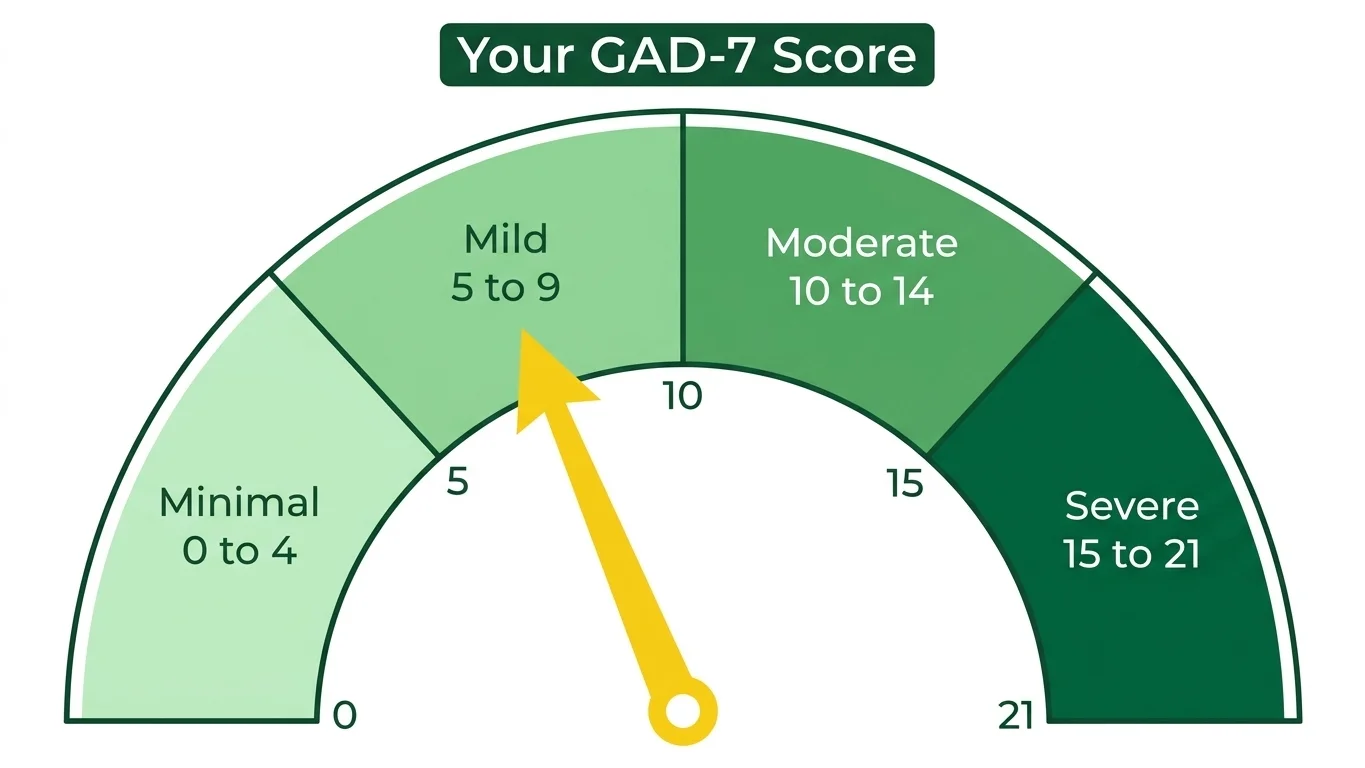
| GAD-7 Score | Anxiety Level | What It Means |
| 0 to 4 | Minimal | Anxiety barely affects your day |
| 5 to 9 | Mild | You notice anxiety, but you can manage it |
| 10 to 14 | Moderate | Anxiety often gets in the way of work, sleep, or relationships |
| 15 to 21 | Severe | Anxiety affects most of your day |
A drop of 4 points or more usually means real progress. In the 2022 BMC Psychiatry study, the typical score dropped from 14 to 7, which is a move from moderate to mild anxiety.
How you handle each session is part of the picture too. Your provider notes any side effects and uses this to shape your next dose. After the series ends, follow-up visits show whether your gains are lasting or whether you may need more support.
Our psychiatrists track your GAD-7 scores at every visit, so any change to your treatment plan is based on your own progress.
Options When Ketamine Does Not Help
Ketamine does not work for everyone, and if it does not help you, that does not mean your anxiety cannot be treated. 1 or 2 sessions is usually too soon to judge, so most providers wait until the full series is done before deciding.
If there is still no real change, your provider may check your diagnosis again, adjust your other medicines, or add therapy. More ketamine is not always the answer. If a full series did not help, extra sessions often will not either, and treatments like TMS or a change in medicine may be a better fit.
Is Repeated Ketamine Treatment Safe?
Repeated ketamine treatment is generally safe in a monitored medical setting, but it is not risk-free.
Common Short-Term Side Effects
Common effects include nausea, dizziness, blurry vision, and feeling detached. A literature review by Michael Banov and colleagues, including Duke University researchers, in CNS Spectrums (2020) found ketamine is generally well tolerated in anxiety. The authors also said the effects of long-term use are still unknown.
Risks Associated With Long-Term Use
Possible concerns with long-term use include bladder problems, misuse, and memory effects. A review of ketamine-induced cystitis found that bladder problems are mainly linked to frequent, high-dose recreational use, and that symptoms rise with the dose and how often ketamine is used. This is one reason providers aim for the lowest number of sessions that work.
Combining Ketamine With Therapy
Many providers recommend pairing ketamine with therapy. Ketamine can ease symptoms quickly, while therapy helps you build skills that last after treatment ends. Some providers offer ketamine-assisted psychotherapy (KAP), where therapy is built into the sessions. Researchers think ketamine may make thinking more flexible for a short time, though this idea still needs more study.
Timing also matters. Many providers schedule therapy within 1 to 3 days after a session rather than right after it, when you may still feel groggy.
If you are in crisis: If you are thinking about suicide or feel unsafe right now, call or text 988 to reach the 988 Suicide & Crisis Lifeline, or call 911.
Get Professional Guidance for Ketamine Treatment
If depression and anxiety still control your days after 2 or more treatments, a psychiatric evaluation is the next step. At Placid Psychiatry in Fullerton, CA, our team offers full psychiatric evaluations to see whether Spravato (esketamine) fits your needs. Spravato is for adults with treatment-resistant depression, including people whose depression comes with anxiety. If Spravato is not the right fit, we will talk with you about other anxiety treatment options. Call us at 562-354-0002 or schedule your appointment today.
Frequently Asked Questions
Do I Have to Finish the Full Ketamine Series?
Not always. Your provider reviews your progress during the series. If your symptoms improve early, the series may end sooner, and if they improve slowly, your provider may adjust the plan.
Can a Single Ketamine Session Help Anxiety?
Yes, for a short time. Relief can start within hours but usually fades within days. A full series gives the benefits a better chance to last.
Is Ketamine Treatment for Anxiety Covered by Insurance?
Usually no. Ketamine is used off-label for anxiety, so most plans do not cover it. Spravato (esketamine) is more likely to be covered when prescribed for approved types of depression. Check with your insurer before starting.
Can Ketamine Make Anxiety Worse?
Yes, briefly, during the session. Some people feel uneasy as the medicine takes effect, but this feeling usually fades as the session ends. Tell your provider so they can adjust your dose or setting.
Can I Keep Taking My Anxiety Medicines During Ketamine Treatment?
Yes, in most cases. However, a 2020 study in Frontiers in Psychiatry found that higher daily doses of benzodiazepines may weaken ketamine’s effect. Your provider will review your list and tell you if anything should change.
Is Ketamine or Esketamine for Anxiety FDA-Approved?
No. Neither ketamine nor esketamine for anxiety is FDA-approved, so both are used off-label. Esketamine (Spravato) is FDA-approved only for certain types of depression.
Conclusion
There is no single answer to how many ketamine treatments for anxiety a person needs. Most plans start with a short series and a review, and some people go on to need booster visits. Your symptoms, treatment history, early response, and the way ketamine is given all shape the plan. Research shows ketamine can ease hard-to-treat anxiety, but relief can fade, so a careful plan and regular check-ins with a professional matter most.