
Have you ever looked for help and seen two different words? Some clinics say “mental health.” Others say “behavioral health.” It’s confusing, and you’re not alone. Even people who work in this field mix them up.
The two ideas overlap a lot. But each one looks at a different side of how you’re doing.
Mental health is your inner life. It’s your thoughts and your moods. It’s also how you handle stress from work, family, or a hard month.
Behavioral health is what you do each day. It’s when you go to bed. It’s whether you eat regular meals. It’s whether you still exercise. It’s also whether a glass of wine after work has slowly become something you need.
Anxiety shows how these two sides connect. Here’s an example. Someone starts out with constant worry. A few months later, they lie awake until 3 a.m. They say no to friends because everything feels like too much.
They pour a drink to calm down. The next morning, the worry is even worse. Sometimes it’s hard to tell where the problem starts. A psychiatric evaluation at Placid Psychiatry in Fullerton, CA is a good first step. A psychiatrist will talk with you about your symptoms. Then you can pick the kind of care that fits you.
What Is Mental Health?
Mental health is a big part of your overall health. It affects how you think and feel. It affects how you deal with stress and make choices. It also affects how you connect with other people.
Good mental health doesn’t mean being happy all the time. Everyone feels sad, worried, angry, or stressed sometimes. It becomes a problem when the feelings are very strong, last a long time, or make daily life hard.
Here are two examples:
- Someone with ongoing anxiety may have trouble sleeping or focusing at work.
- Someone with depression may stop enjoying things they used to love.
These problems can hurt work, school, friendships, and everyday tasks.
Mental health can also change over time. Many things can play a part, like:
- Stress
- Trauma
- Family history
- Physical health
- Relationships
- Big life changes
Mental health problems are common. The National Institute of Mental Health says about 59.3 million adults in the U.S. had a mental illness in 2022. That’s about 1 in 4 adults (23.1%).
Common Mental Health Conditions
Many conditions can affect mental health. Here are some of the most common ones:
- Anxiety can cause strong worry, fear, and restlessness. It can also cause physical symptoms.
- Depression can change your mood, energy, sleep, appetite, and focus. It can also take away your interest in things you normally like to do.
- Bipolar disorder can cause big swings in mood and energy. There are high-energy times (called mania) and very low times (depression).
- PTSD (post-traumatic stress disorder) can happen after a scary or traumatic event. You may have unwanted memories. You may avoid things that remind you of it. Your mood may change, and you may feel on guard all the time.
These conditions can also change how a person acts. That’s one reason it’s hard to tell mental health and behavioral health apart.
What Is Behavioral Health?
Behavioral health looks at how your actions and habits affect your health. It includes mental health, but it also covers other behaviors that can affect your mind and body. These can include sleep, eating, exercise, alcohol or drug use, gambling, handling stress, and other daily habits.
The word “behavioral” doesn’t mean good behavior or bad behavior. It just means we look at your patterns and how they may affect your health. The two problems may be connected. If only one is treated, the other can still cause trouble.
What Can Behavioral Health Include?
Behavioral health covers many parts of everyday life. That’s one reason it’s often wider than mental health.
- Substance use. A person may keep using alcohol or drugs even when it causes problems at home, at work, or with their health. It can be linked to stress, trauma, anxiety, or depression.
- Eating habits. Some people struggle with binge eating, eating too little, or other eating patterns that hurt their health.
- Sleep. Staying up very late every night can lead to tiredness, trouble focusing, and mood changes.
- Other concerns. These can include gambling problems, pulling away from other people, unhealthy ways of coping, and trouble keeping healthy routines.
The goal is never to blame anyone. The goal is to understand what’s going on and how it affects their health.
Behavioral Health vs Mental Health: Key Differences
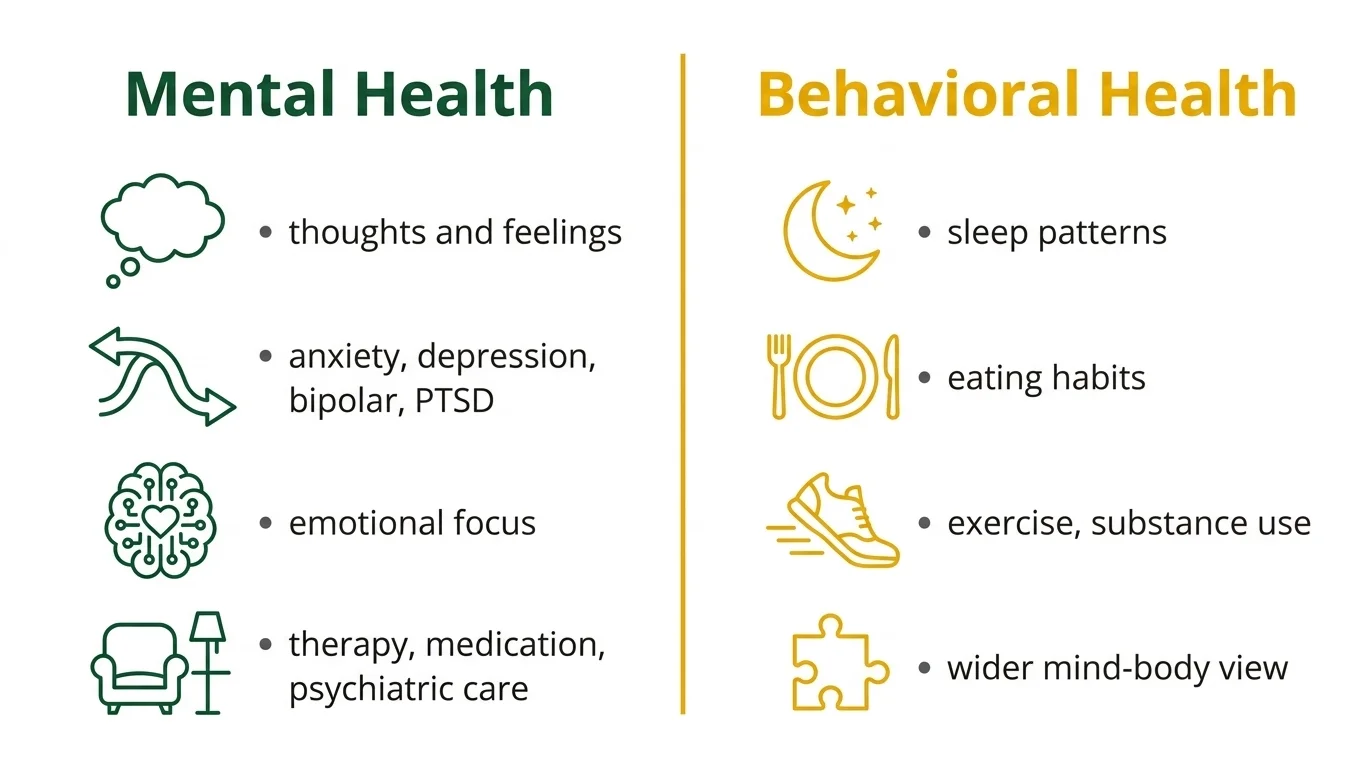
It’s easier to see the difference when you look at what each one focuses on.
| Mental Health | Behavioral Health |
| Focuses on thoughts, feelings, and emotional well-being | Looks at behaviors, habits, and daily patterns |
| Includes conditions like anxiety, depression, bipolar disorder, and PTSD | Can include sleep, substance use, eating, exercise, and other behaviors |
| Focuses mainly on mental and emotional health | Takes a wider look at mental, physical, and behavioral health |
| May involve therapy, medication, or psychiatric care | May involve therapy, changing habits, medication, or other kinds of care |
These two areas can overlap. A person can have a mental health condition and a behavioral health concern at the same time. For example, depression may make someone stop exercising and avoid friends. Those changes can make daily life even harder. That’s why the line between mental health and behavioral health isn’t always clear.
How Behavioral Health and Mental Health Are Connected
Your mind and your habits affect each other. Say someone has depression. They may stop exercising, stay away from friends, sleep too much, or quit doing things they normally do. That makes it harder to stay active and close to other people.
Anxiety works in a similar way. If you feel very nervous around people, you might start skipping social events. After a while, you may feel more alone. It can go the other way too. Poor sleep, drinking a lot, not moving much, and unhealthy ways of coping can change your mood and make daily life harder.
A paper called Meeting the Needs of Justice-Involved People With Serious Mental Illness Within Community Behavioral Health Systems talks about this. It says mental health care and substance use care sometimes need to work together. The authors also say these services should connect with other kinds of help.
So it’s not always “behavioral health or mental health.” Sometimes a person needs help with more than one thing.
Behavioral Health vs Psychiatry: What Is the Difference?
Behavioral health and psychiatry are connected, but they aren’t the same. Behavioral health is a big area. It looks at mental health, habits, substance use, and other things that can affect your health. Psychiatry is a type of medical care.
Psychiatrists are medical doctors who find and treat mental, emotional, and behavioral problems. They may ask about your mood, thoughts, sleep, stress, substance use, medicines, and daily life. This helps them see the whole picture.
What Does a Psychiatrist Do?
A psychiatrist is a medical doctor who treats mental health conditions. At an appointment, they may ask about your symptoms, mood, thoughts, sleep, and stress. They may also ask about your medical history, medicines, substance use, and daily routine. These questions help the psychiatrist figure out what may be causing your symptoms or making them worse.
Treatment can include medicine, ideas for therapy, referrals to other providers, or a mix of these. Psychiatrists may treat depression, anxiety, bipolar disorder, PTSD, and ADHD. Other behavioral health professionals can also help with substance use, coping skills, stress, habits, and other concerns.
Behavioral Medicine vs Psychiatry
People sometimes mix up behavioral medicine and psychiatry. Behavioral medicine looks at how your behavior, your thoughts, and your body’s health are connected. It uses ideas from both medicine and behavioral science.
A paper called Proposal for an Update of the Definition and Scope of Behavioral Medicine says behavioral medicine puts medical and behavioral knowledge together. It covers staying healthy, finding problems, treating them, and helping people recover.
Another paper, Definition and Characteristics of Behavioral Medicine, and Main Tasks and Goals of the International Society of Behavioral Medicine: An International Delphi Study, says people from many fields work in behavioral medicine. They use both behavioral and medical knowledge to look at health and disease.
Psychiatry has a different job. It’s a medical specialty that focuses on mental, emotional, and behavioral disorders. So comparing behavioral medicine and psychiatry is not the same as comparing behavioral health and mental health. Behavioral medicine is a broad field that links behavior and physical health. Psychiatry is a medical specialty.
When Should You Seek Mental or Behavioral Health Support?

You don’t have to wait until a problem is severe to ask for help. It may be time to talk with a professional when changes in your mood, behavior, sleep, or substance use keep going and start to cause problems. Signs can include ongoing sadness, strong anxiety, big changes in sleep, using more alcohol or drugs, pulling away from people, or trouble controlling a behavior.
You may also want to talk with someone if a problem gets in the way of your work, school, relationships, or daily tasks. Getting help doesn’t mean something is wrong with you. It means you take your health seriously.
If you are having thoughts of hurting yourself or ending your life, get help right away. Call emergency services or a crisis line in your area.
Common Mistakes People Make About Behavioral and Mental Health
People often mix up these terms. Some think mental health and behavioral health are exactly the same. Others think behavioral health is only about personal choices. They do overlap, but they aren’t identical. Behavioral health also looks at the habits and behaviors that can affect your health.
Another common mistake is blaming people for their behavior. A behavior may be linked to stress, trauma, mental health symptoms, physical health, or other problems in life.
Trying to figure it out on your own can also be a problem. Many symptoms have more than one cause. For example, poor sleep may come from stress, anxiety, depression, medicine, physical health, or daily habits.
Some people also talk about one problem and leave out another. Someone may mention drinking but not their anxiety. Someone else may talk about depression but not their sleep problems. Telling the whole story helps a provider understand what’s really going on.
How Are Mental and Behavioral Health Concerns Evaluated?
A professional evaluation looks at more than one symptom. A provider may ask about what’s bothering you now, your medical history, your medicines, and your family history. They may also ask about your sleep, substance use, relationships, work, stress, and daily routine.
For example, trouble sleeping can have many causes. It may be linked to stress, anxiety, depression, medicine, an uneven sleep schedule, or another health problem. Looking at all these details helps a provider understand the problem better. It can also show when more than one concern is there. That helps decide the next steps in care.
Treatment for Mental and Behavioral Health Concerns
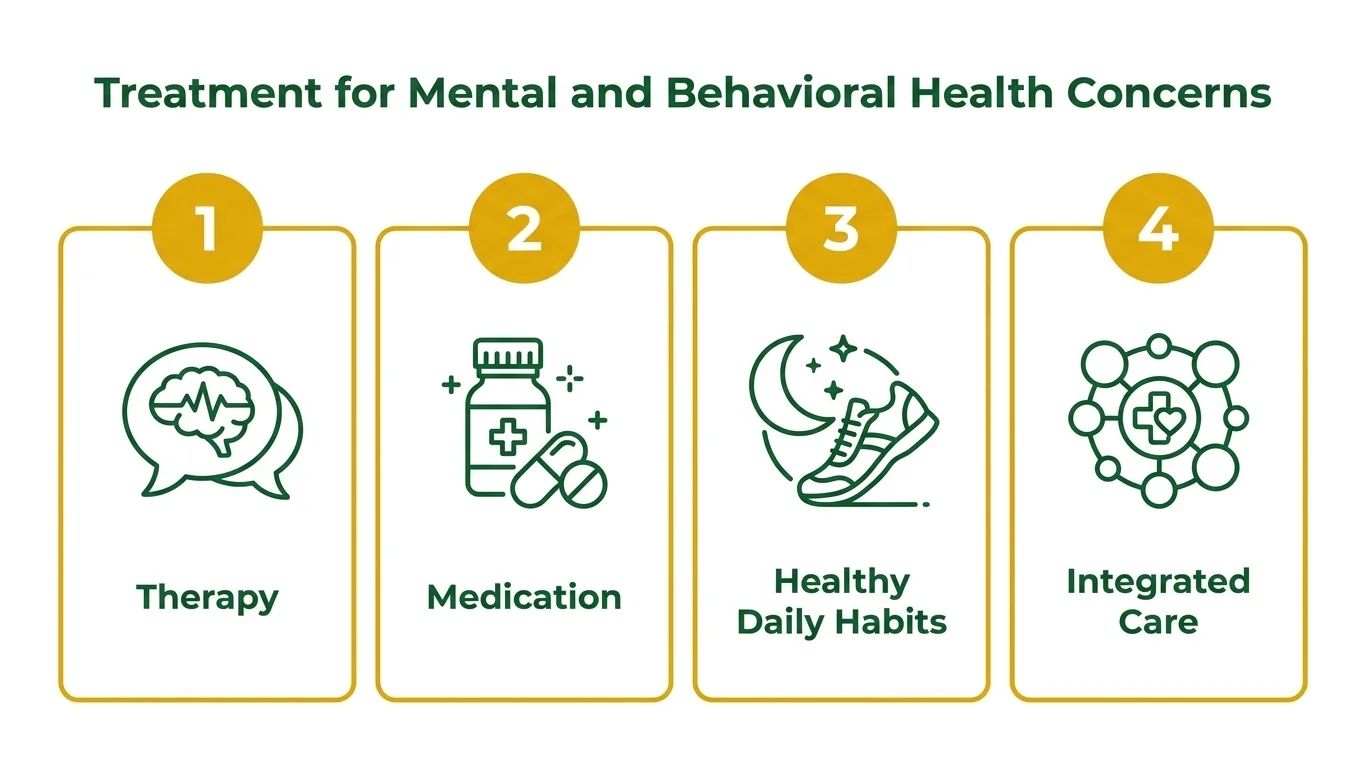
Treatment depends on the person’s symptoms, health history, needs, and goals. No single treatment works for everyone.
Therapy
Therapy can help people understand their thoughts, feelings, behaviors, and coping habits.
Cognitive Behavioral Therapy, or CBT, is one type of therapy used for many mental and behavioral health concerns. It helps people notice thought patterns that aren’t helping them and learn healthier ways to respond. Other types of therapy may also be used, depending on what a person needs.
Medication
Medicine may help some people manage mental health conditions. Psychiatrists may prescribe antidepressants, mood stabilizers, or other medicines when they make sense.
Before prescribing, a provider may look at your symptoms, medical history, and current medicines. They may also think about possible side effects and other health concerns.
Healthy Daily Habits
Daily habits can support your mental and behavioral health too. Moving your body, eating healthy meals, managing stress, and keeping a steady sleep schedule can all help.
Sleep matters a lot because it affects your mood, focus, and energy. CDC data show that 30.5% of U.S. adults slept less than seven hours a day on average in 2024.
Poor sleep doesn’t always mean someone has a mental health disorder. But sleep and mental well-being do affect each other.
Integrated Care
Some people have more than one concern at the same time. For example, a person may have depression, drink alcohol, and sleep poorly. Looking at all three together can help a provider better understand what the person needs.
This kind of care can help when mental health, behavior, and physical health problems overlap.
Real-Life Situations Where the Two Overlap
Everyday examples make the link between mental health and behavioral health easier to see. A person with anxiety may start drinking every evening because alcohol helps them feel calm for a short time. The anxiety and the drinking are different problems, but they are connected.
Someone with depression may stop exercising, avoid friends, sleep at odd hours, and lose interest in normal activities. Depression can change behavior. Those changes can then make daily life even harder.
A person can also have a behavior problem without having a mental health disorder. For example, staying up late because of work, phone use, or a messy schedule can cause tiredness and trouble focusing.
These examples show why behavioral health can be wider than mental health. Not every behavior problem comes from a mental health disorder. But behaviors can still affect your health.
Why Understanding the Difference Matters
Knowing the difference can help you explain your concerns more clearly. It can also help you see why a provider may ask about more than your mood or thoughts. Sleep, substance use, eating, exercise, stress, relationships, and daily habits can all matter.
For example, someone with anxiety and alcohol use may need care that looks at both. Someone whose poor sleep comes from an uneven routine may need a different kind of help. It can also help people feel less ashamed. Mental and behavioral health concerns are health concerns. They are not signs of weakness or bad character.
Conclusion
Behavioral health and mental health are closely connected, but they aren’t exactly the same.
Mental health is mostly about your thoughts, feelings, emotions, and inner well-being. Behavioral health takes a wider look at the habits and behaviors that can affect your mental and physical health.
The difference is easier to see when you look at the whole person. Your feelings can affect your behavior, and your behavior can affect how you feel.
Get Support for Your Mental and Behavioral Health
At Placid Psychiatry in Fullerton, CA, a psychiatric evaluation can help you understand your symptoms and your treatment options.
If you’re dealing with anxiety, depression, PTSD, bipolar disorder, ADHD, substance use concerns, or other mental or behavioral health concerns, you can schedule an appointment to talk with a qualified provider.
Frequently Asked Questions
What is the difference between behavioral health and mental health?
Mental health is about your thoughts and feelings. It’s how you feel inside. Behavioral health is wider. It also looks at your daily habits, like how you sleep, eat, and whether you use alcohol or drugs.
Is behavioral health broader than mental health?
Yes. Behavioral health looks at the bigger picture. It includes mental health, and it also covers habits and actions that can affect your mind and body.
How are mental health and behavioral health related?
They affect each other. A mental health problem can change how a person acts. Habits like poor sleep, using drugs or alcohol, or pulling away from people can also hurt how you feel inside.
What is the difference between behavioral health and psychiatry?
Behavioral health is a big area. It includes mental health, habits, and other things that affect your health. Psychiatry is a type of medical care. Psychiatrists are doctors who find and treat mental, emotional, and behavioral problems.
What is the difference between behavioral medicine and psychiatry?
Behavioral medicine looks at how your behavior, your thoughts, and your body’s health are linked. Psychiatry is a medical specialty. Psychiatrists are doctors who treat mental, emotional, and behavioral problems.
Can behavioral health problems affect physical health?
Yes. Poor sleep, drug or alcohol use, not moving much, and unhealthy eating can hurt your body. Your mental health and your physical health can also affect each other.