
If you are looking for help with trauma, anxiety, painful memories, or emotional distress, you may have heard about Brainspotting and EMDR. Understanding Brainspotting vs. EMDR can help you learn how these two therapy approaches are different and what each one may offer.
Both approaches can be used to help people work through distressing experiences. However, they do not use the same process. EMDR follows a structured treatment method, while Brainspotting gives more attention to eye position, focused attention, and the person’s internal experience.
At Placid Psychiatry in Fullerton, CA, a qualified mental health professional can help you understand your treatment options and decide what may fit your needs. This guide explains Brainspotting and EMDR, including how they work, their similarities and differences, research, safety, treatment sessions, and how to choose the right approach for you.
What Is Brainspotting?
Brainspotting is a therapy approach that uses visual focus and attention while a person explores difficult emotions, memories, or physical sensations.
The method was developed by therapist David Grand. During a session, a therapist may help you notice where you naturally look when thinking about a difficult experience. A certain position in your visual field may bring up a stronger emotional or physical response. This point may then become the focus of the session.
Brainspotting does not require you to tell your therapist every detail of a difficult experience. Instead, you may spend time noticing what happens inside you while keeping your attention on a particular visual point. The therapist stays with you during the process and helps you work through what comes up at a pace that feels manageable.
What Is Brainspotting Used For?
Brainspotting may be used to help people work through trauma, distressing experiences, difficult memories, anxiety, emotional distress, and strong emotional reactions. It may also be helpful for people dealing with stress or other concerns that involve difficult emotions. A trained therapist can assess your needs and decide whether Brainspotting is a suitable part of your treatment.
 How It Works & What a Session Looks Like
 How It Works & What a Session Looks Like
Brainspotting uses eye position to access and process difficult emotions, memories, or physical sensations. Where you naturally look when thinking about something distressing connects to how your brain and body are holding onto it, so your therapist doesn’t need a detailed retelling, just what you notice happening inside you.
A session starts with a short conversation about what you want to work on. Your therapist then guides your eyes across your visual field until they find a point connected to what you’re feeling. You hold your gaze there, noticing whatever comes up, while your therapist supports you and uses grounding techniques if needed. The session closes with a brief check-in.
What Is EMDR?
EMDR stands for Eye Movement Desensitization and Reprocessing. It is a structured psychotherapy approach that is widely used to treat PTSD and trauma-related symptoms. EMDR has a larger research base than Brainspotting. Major clinical guidelines include EMDR among the recommended trauma-focused treatments for PTSD.
EMDR focuses on distressing memories and the thoughts, feelings, body sensations, and beliefs connected to those memories. The goal is not to erase a memory. Instead, treatment aims to help the memory become less distressing and easier to manage.
What Is EMDR Used For?
EMDR is best known for treating PTSD and trauma-related symptoms. A trained therapist may also use it to address distressing memories, anxiety related to difficult experiences, negative beliefs, and other mental health concerns when appropriate. Your therapist can assess your situation and determine whether EMDR is a good fit for your treatment.
How It Works & What a Session Looks Like
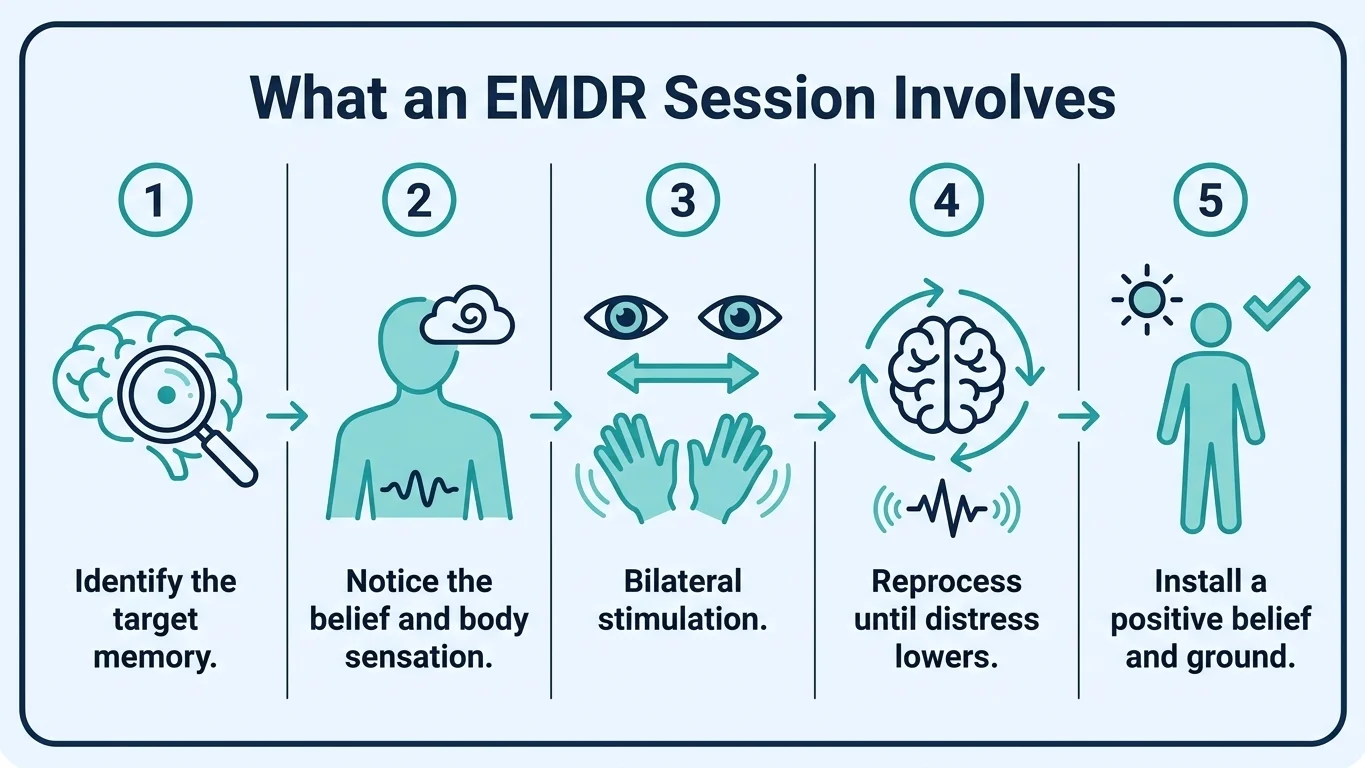
EMDR is a structured approach built around bilateral stimulation, meaning alternating eye movements, taps, or sounds used while you focus on a specific distressing memory, following a defined sequence of phases. Your therapist explains the process and teaches coping tools before you begin. You then identify the target memory along with its negative belief and related emotion or sensation.
During processing, you focus on the memory while following guided eye movements or taps, with your therapist checking in and adjusting pace as needed. Once the memory feels less distressing, your therapist helps you install a more adaptive belief, and the session ends with grounding.
Brainspotting vs. EMDR: What Is the Difference?
Brainspotting and EMDR can both be used to help people work through distressing experiences. However, they differ in structure, techniques, and how the therapist guides the session.
| Feature | Brainspotting | EMDR |
| Main Approach | Uses eye position and focused attention to explore difficult experiences. | Uses a structured process to help people process distressing memories. |
| Structure | Generally more flexible and guided by the client’s experience. | Follows a structured treatment protocol. |
| Eye Focus | Uses a specific point in the person’s visual field as a focus. | Often uses guided eye movements as part of bilateral stimulation. |
| Bilateral Stimulation | Not a required part of the approach. | Commonly uses alternating eye movements, sounds, or taps. |
| Therapist’s Role | Guides the client while following their thoughts, feelings, and body responses. | Guides the client through specific stages of the EMDR process. |
| What You May Focus On | Emotions, memories, thoughts, and physical sensations. | Distressing memories, emotions, beliefs, and physical sensations. |
| Treatment Experience | May feel more open and flexible. | May feel more structured and step-by-step. |
| Research Base | Research is still developing. | Has a larger research base, especially for PTSD. |
| Best Choice | Depends on your needs, goals, and therapist’s expertise. | Depends on your needs, goals, and therapist’s expertise. |
Brainspotting vs. EMDR: Similarities
Despite their differences, Brainspotting and EMDR share several features. Both can be used as part of trauma-focused therapy. Both involve focused attention and therapist guidance. Both may involve memories, emotions, thoughts, and physical sensations.
Other similarities include:
- Both require active participation.
- Both can involve difficult memories.
- Both may bring up emotional responses.
- Both may involve physical sensations.
- Both are guided by trained therapists.
- Both can be adapted to individual needs.
- Both should be provided in a supportive setting.
The important thing to remember is that neither therapy is guaranteed to work the same way for everyone.
Is Brainspotting or EMDR More Effective?
There is no single answer because the right therapy depends on the person’s symptoms, goals, and treatment needs. EMDR has a much larger research base, especially for PTSD and trauma-related symptoms. Brainspotting is also used by trained therapists, but research on it is still developing.
This does not mean EMDR is always better for everyone. Some people may prefer the structured approach of EMDR, while others may feel more comfortable with the flexible style of Brainspotting. A qualified therapist can help you compare both options and choose an approach based on your needs and treatment goals.
Research support is one important factor to consider, but it is not the only one. Your comfort with the therapy, the therapist’s training, the type of concerns you want to address, and your treatment history can all affect which approach may work best for you. Talking with a qualified therapist can help you make an informed choice.
Can Brainspotting and EMDR Be Combined?
A therapist may use different therapy approaches during treatment depending on the client’s needs and the therapist’s training. However, combining Brainspotting and EMDR is not automatically better.
If you are already using one approach and want to try the other, discuss it with your therapist first. Your treatment plan should have a clear purpose and should be based on your individual needs. The goal is to find an approach that supports your treatment, not simply to use as many techniques as possible.
How Many Sessions Do Brainspotting and EMDR Take?
There is no fixed number of sessions for Brainspotting or EMDR. The amount of therapy you need can depend on your symptoms, treatment goals, personal history, the complexity of your concerns, and how you respond to treatment. Some people may need a shorter course of therapy, while others may need longer support.
| Therapy | Number of Sessions |
| Brainspotting | The number of sessions varies based on your needs, goals, and response to therapy. |
| EMDR | The number of sessions varies based on your concerns, treatment goals, history, and response to therapy. |
What Can Affect the Number of Sessions?
Two important factors include:
- Your treatment needs: More complex or long-term concerns may require more time and support.
- Your response to therapy: Your therapist may adjust the treatment plan based on your progress and how you respond to each session.
It is better to discuss your expected treatment length with your therapist than to trust promises that trauma can be resolved within a certain number of sessions.
How Long and How Often Are Sessions?
A single Brainspotting or EMDR session typically runs 50 to 90 minutes, depending on the therapist and what’s being processed that day. Brainspotting sessions are sometimes run longer than a standard therapy hour since finding a spot and staying with it can take extra time. Most people attend sessions weekly, though some therapists space sessions out biweekly depending on how someone is responding to treatment and how much processing time they need between visits.
Are Brainspotting and EMDR Safe?

Trauma therapy can sometimes bring up strong emotions, memories, thoughts, or physical sensations. This is why trauma processing should be done with appropriate professional support. A trained therapist should help you understand the process and make sure you have ways to manage distress.
If you have a history of complex trauma or dissociation, it is especially important to discuss this with your therapist. Your provider can determine what type of treatment and pace may be appropriate. You should also tell your therapist if a therapy exercise feels overwhelming.
Therapy should not be about forcing yourself through distress as quickly as possible. A therapist can slow down the process, pause when needed, or use grounding strategies to help you stay within a manageable level of distress.
Are Brainspotting and EMDR Covered by Insurance?
EMDR is a recognized, billable treatment, and many insurance plans cover it, though coverage details vary by provider and plan. Brainspotting is newer and not as widely recognized by insurers, so coverage is less consistent. Before starting either therapy, it’s worth checking with your insurance provider and your therapist’s office to understand what’s covered and what your out-of-pocket cost may look like.
Conclusion
Brainspotting and EMDR are two different approaches that may be used to help people work through trauma and distressing experiences. EMDR is more structured and has a much larger research base, especially for PTSD. Brainspotting is generally more flexible and uses visual focus as part of the therapy process.
There is no single therapy that is right for everyone. Your symptoms, goals, treatment history, comfort level, and therapist’s experience all matter when choosing a treatment. If you are considering Brainspotting or EMDR, speak with a qualified mental health professional. They can help you understand your options and create a treatment plan based on your needs.
Take the Next Step Toward Trauma Recovery
If trauma, anxiety, or distressing memories are affecting your daily life, professional support can help you understand your symptoms and explore appropriate treatment options. Placid Psychiatry in Fullerton, CA provides personalized mental health care based on each person’s needs and treatment goals.
If you are considering EMDR, Brainspotting, or another therapy approach, speak with a qualified mental health professional to learn which option may be right for you. Schedule a consultation today to talk through your options and take the first step toward a treatment plan built around you.
Frequently Asked Questions
Is Brainspotting better than EMDR?
Neither therapy is universally “better.” EMDR has stronger research support, especially for PTSD, but Brainspotting works well for some clients depending on their needs and how they respond to each style of processing.
What’s the core difference between Brainspotting and EMDR?
EMDR follows a structured, staged protocol built around bilateral stimulation. Brainspotting is more flexible, using a fixed eye position to help surface and process what the client is already feeling internally.
Does Brainspotting have the same research backing as EMDR?
Not yet. EMDR is included in major PTSD treatment guidelines and has decades of clinical studies behind it. Brainspotting’s evidence base is smaller and still growing.
Can a therapist combine Brainspotting and EMDR in my treatment?
Yes, some therapists use both depending on training and client needs but combining them isn’t automatically more effective. It should be a deliberate choice tied to your specific treatment plan, not just layering techniques.
How much does treatment typically cost, and is it covered by insurance?
EMDR is a recognized, billable treatment that many insurance plans cover. Brainspotting coverage is less consistent since it’s newer and not as widely recognized by insurers check with your provider and your therapist’s office before starting.
How many sessions will I need?
There’s no fixed number for either therapy. It depends on the complexity of what you’re working through, your personal history, and how you respond to treatment. Your therapist will adjust the plan as you go.
Can I do Brainspotting or EMDR through telehealth?
Many therapists offer both through telehealth, though EMDR’s bilateral stimulation techniques (like tapping or tones) sometimes need slight adaptation for a virtual format. Ask your provider whether their telehealth setup supports the approach you’re interested in.