
Bipolar disorder changes the speed and content of a person’s thinking depending on their mood state. During mania, thoughts move fast, ideas jump quickly from one to the next, and confidence often rises sharply. During depression, thinking slows down, decisions become harder, and negative thoughts tend to feel accurate rather than like symptoms. Even in stable periods, some people notice lingering effects on attention, memory, or planning.
In mania, this often shows up as racing thoughts, flight of ideas, and impulsive decisions the person wouldn’t normally make. In depression, it tends to look like mental fog, repetitive negative thinking, and difficulty concentrating on even simple tasks. One key thread runs through both: insight, meaning the ability to recognize a thought as a symptom rather than fact, tends to drop during active episodes and return once the episode passes.
Understanding these patterns helps both the person living with bipolar disorder and the people around them make sense of behavior that can otherwise feel confusing or out of character. Below, we break down how thinking changes across mania, depression, mixed episodes, and stable periods, what the research says about cognitive effects between episodes, and how to support someone based on which pattern they’re experiencing.
How Bipolar Disorder Affects Thinking
Bipolar disorder speeds thinking up during mania and slows it down during depression. Manic thinking tends to involve racing thoughts, jumping between ideas, inflated confidence, and impulsive decisions. Depressive thinking tends to involve mental fog, repetitive negative thoughts, and difficulty making even small decisions. Some cognitive effects, particularly with attention, memory, and planning, can also linger during stable mood periods.
Thinking Patterns Across Bipolar Mood States, Side by Side
It helps to see the whole picture before going phase by phase. Here’s how thought speed, common patterns, and self-awareness tend to shift across each mood state, including euthymia, the clinical term for a period of stable mood between episodes.
| Mood State | Thought Speed | Common Cognitive Pattern | Insight Into Symptoms |
| Mania | Very fast | Racing thoughts, flight of ideas, grandiosity | Often significantly reduced |
| Hypomania | Fast | Similar to mania, but milder and easier to manage | Often partially retained |
| Depression | Slow | Rumination, negative self-talk, indecision | Negative thoughts feel accurate rather than distorted |
| Mixed episode | Fast and slow at the same time | Physical agitation paired with hopelessness | Highly variable, often confusing to the person experiencing it |
| Euthymia (stable mood) | Close to baseline | Subtle attention, memory, or planning effects may persist | Usually highest. Past episodes are easier to recognize as illness related |
Insight, meaning the ability to recognize a thought as a symptom rather than as fact, rises and falls with mood state. That single shift explains a surprising amount of the confusion both patients and the people around them experience.
How Thinking Changes During Mania and Hypomania

During mania or hypomania, thinking speeds up. Ideas arrive faster than they can be said out loud, confidence climbs sharply, and the mental pause that would normally catch a risky decision before it’s made weakens considerably. That’s part of why manic decisions so often look impulsive or out of character to people who know the person well.
Hypomania involves the same general pattern as mania, just less intense and shorter-lived, and it doesn’t include the loss of touch with reality that can happen in full mania.
What Are Racing Thoughts and Flight of Ideas?
Racing thoughts describe a rapid, relentless stream of ideas that move faster than someone can verbalize them. When this intensifies, it becomes a flight of ideas: jumping quickly from topic to topic in a way that feels connected internally but is hard for a listener to follow.
People who experience this often know their thoughts are racing but can’t slow them down on their own. Without treatment, willpower alone won’t resolve it.
Why Mania Often Comes With Inflated Confidence
A manic mind frequently produces an exaggerated sense of one’s own ability, importance, or plans, and it doesn’t feel like exaggeration from the inside. It feels true. People have compared the sensation to walking into a courtroom already certain of winning, or feeling armored against doubt in a way that makes them bolder and less self-conscious than usual.
Why Manic Decisions Tend to Be Impulsive
Speed and confidence together tend to override the step where risk normally gets weighed. That combination is a major reason manic episodes are so often linked to overspending, sudden major decisions, risky sexual behavior, or substance use. It isn’t that judgment turns “bad” so much as the deliberation step gets skipped or compressed into almost nothing.
What Does Psychosis Look Like During Severe Mania?
In the most severe manic episodes, thinking can break from reality entirely, a state known as psychosis. This is specific to full mania. By definition, hypomania does not involve psychosis; if psychotic symptoms appear, the episode is classified as mania rather than hypomania, regardless of how it started. Manic psychosis usually takes one of two forms.
Grandiose Delusions
A person becomes fully convinced of something untrue about their own importance or abilities, such as believing they have a special purpose, unique power, or destiny that sets them apart from everyone around them.
Persecutory Delusions
Persecutory delusions involve a fixed belief that others are watching, plotting against, or planning to harm you, with no evidence to support it.
Both forms feel completely real to the person experiencing them. Psychosis during mania is treatable and typically eases as the episode comes under control, but it isn’t something to manage without professional support.
Why Insight Drops During Acute Mania
During an active manic episode, distorted or grandiose thoughts feel completely logical in the moment. Insight typically returns only after the episode passes, which is why most people recognize symptoms in hindsight rather than while they’re happening.
From the inside, mania often feels like unusually high energy, faster speech, urgent connected ideas, and confidence in decisions that carried far more risk than they seemed to at the time.
How Thinking Changes During a Depressive Episode
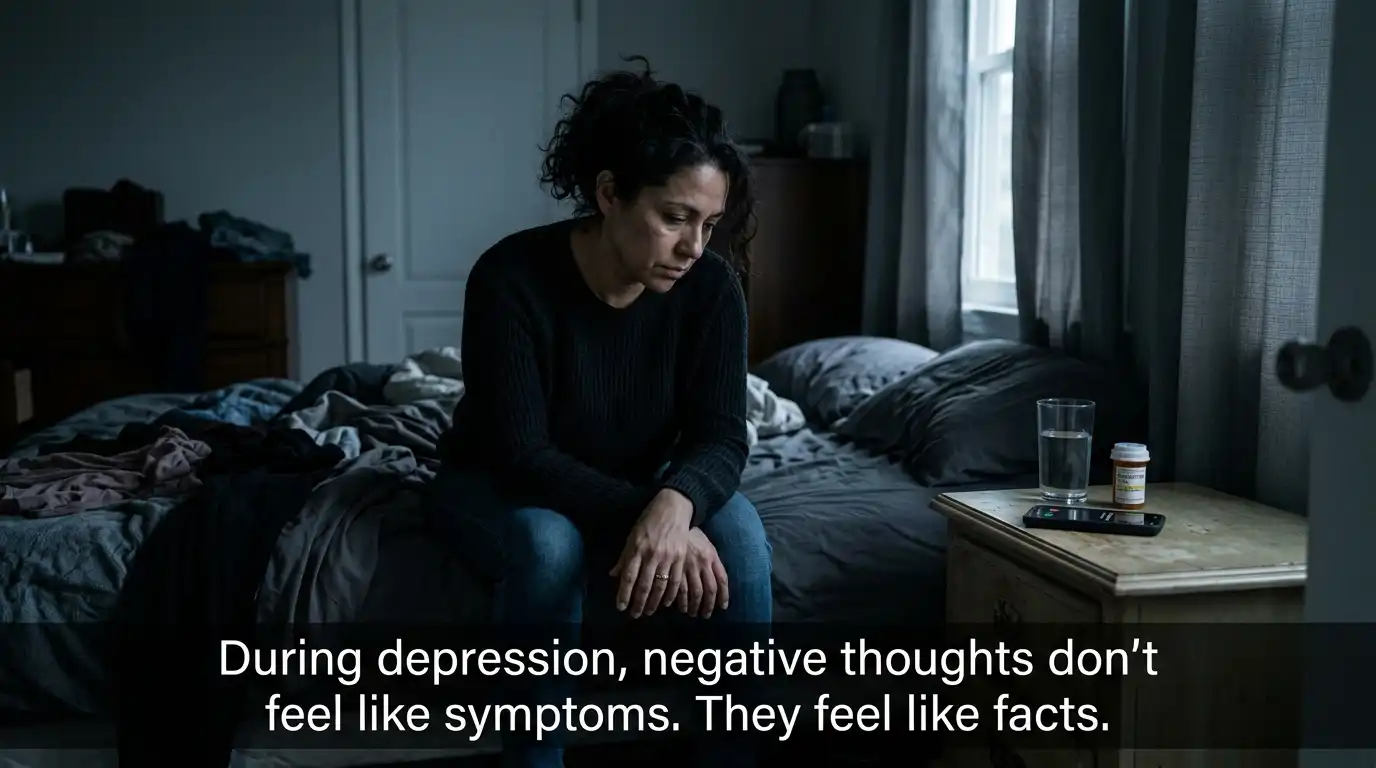
During a depressive episode, thinking slows down instead of speeding up. Decisions that would normally take seconds can take much longer. Concentration becomes hard to sustain, and negative thoughts about the self, the future, or one’s worth tend to feel like accurate conclusions rather than symptoms passing through.
Why Depression Causes Mental Fog
Bipolar depression involves more than low mood alone. Processing speed drops, working memory becomes less reliable, and even small decisions can feel disproportionately heavy. This mental slowing is a real cognitive symptom of the episode, not a matter of motivation or effort.
Why Negative Thoughts Loop During Depression
Depressive thinking often narrows into repetitive negative cycles, phrases like “I’m not good enough” or “this isn’t going to get better” that repeat rather than resolve. Patterns like all-or-nothing thinking and overgeneralizing show up often here, and they tend to make a hard mood feel more fixed and permanent than it actually is.
Why Depressive Thoughts Feel True Instead of Distorted
During depression, the same insight mechanism that fails during mania fails in the opposite direction. Where manic grandiosity feels logical, depressive hopelessness feels factual. That’s why these thoughts are so hard to reason someone out of; they aren’t experienced as distorted, they’re experienced as true.
If depressive thinking includes thoughts of self-harm or suicide, that’s a signal to get help immediately, not a personal failure. In the U.S., the 988 Suicide and Crisis Lifeline is available by call or text, any time of day.
Can Depression Also Involve Psychosis?
Yes, though it’s less common than psychosis during mania. In severe bipolar depression, a person can develop delusions that match the depressive mood, such as a fixed, false belief that they’re responsible for something terrible or that they deserve to be punished. As with manic psychosis, this requires prompt professional treatment rather than home management.
What a Mixed Episode Feels Like
A mixed episode is when manic and depressive symptoms appear at the same time, such as racing thoughts and physical restlessness alongside hopelessness and despair, within the same hours or days.
It’s often described as one of the most disorienting parts of bipolar disorder. A person can feel physically wired and mentally urgent while simultaneously feeling that nothing matters or will improve, two states that would normally call for opposite responses, which is why neither a high-energy nor a low-energy coping approach fully fits.
What Happens to Thinking Between Episodes
Cognitive effects of bipolar disorder aren’t limited to active episodes. Peer-reviewed research consistently shows that measurable difficulties with attention, verbal memory, and planning can continue even during euthymia, the period when mood itself has stabilized. Feeling emotionally stable and being fully recovered cognitively aren’t automatically the same thing.
Which Cognitive Areas Are Most Affected Between Episodes?
Research on mood-stable bipolar patients found the largest cognitive deficits in executive function, verbal learning, and category fluency, with medium-sized deficits in verbal memory, attention, response inhibition, and processing speed.
Three areas show up most consistently: executive function (planning, mental flexibility, task-switching), verbal memory (encoding and recalling spoken or written information), and attention (sustaining focus on less stimulating tasks over time).
What Does the Research Say About How Common This Is?
One study found persistent cognitive deficits in roughly 32% of patients during the remitted, mood-stable phase. A separate controlled study found that euthymic patients performed worse than healthy controls on several memory and executive function measures, even after accounting for leftover mood symptoms, age, and estimated premorbid IQ.
Why Feeling Stable Doesn’t Always Mean Full Cognitive Recovery
Clinical and functional recovery don’t move at the same speed. Most people recover clinically within two years of an episode, but far fewer recover functionally in that same window.
Someone can be mood-stable and still forget things easily, lose their train of thought, or struggle with focused work. That’s a documented part of the condition, not a management failure, and it’s why ongoing psychiatric care matters beyond just getting through the next episode.
Bipolar Thinking vs. Other Conditions: Why It Gets Misdiagnosed
Bipolar disorder gets confused with other conditions often, mostly because mood instability, impulsivity, and relationship strain can look similar on the surface even when the underlying thought pattern is different. Getting this distinction right matters because the treatments aren’t interchangeable.
Bipolar Disorder vs. Borderline Personality Disorder
This is one of the more common mix-ups in clinical practice, partly because both conditions involve emotional intensity and impulsive behavior. The underlying thinking pattern, though, works differently.
| Feature | Bipolar Disorder | Borderline Personality Disorder |
| Mood shift trigger | Largely biologically driven, not necessarily tied to a specific event | Often reactive, triggered by interpersonal situations or fear of abandonment |
| Duration of a mood shift | Days to weeks or longer | Often hours, sometimes shifting several times in one day |
| Sense of self between episodes | Typically stable | Often unstable or fluctuating |
| Core thinking pattern | Thought speed and content change with the episode (racing or slowed) | Emotional reactivity tends to drive thought content, especially around relationships |
Both conditions can involve impulsivity, relationship difficulty, and a higher risk of suicidal thoughts, which is exactly why they get mistaken for each other and why one conversation usually isn’t enough to tell them apart. A thorough evaluation looking at the timeline, duration, and triggers behind mood changes, not just the fact that mood changes happen, is what actually separates them.
How Often Do Bipolar Disorder and BPD Overlap?
Research suggests around 20% of people diagnosed with bipolar disorder also meet criteria for borderline personality disorder, and the real overlap may be higher given how often the two get confused.
Bipolar Mood Swings vs. Normal Mood Swings
Everyone’s mood shifts from day to day. What sets bipolar disorder apart isn’t that mood changes; it’s that the changes come bundled with a sustained shift in energy, sleep need, thought speed, and behavior that lasts for days or longer and noticeably disrupts daily life, rather than passing within hours after a specific trigger.
How to Support Someone Based on How They’re Thinking
What helps during a manic episode can make depressive thinking worse, and the reverse is also true, so support needs to match the actual thought pattern in play, not just the visible behavior.
Supporting Someone During Mania or Hypomania
It generally helps to skip arguing directly with grandiose or urgent-feeling plans in the moment, since insight is reduced and confrontation usually increases agitation instead of producing clarity. Raising specific, concrete concerns, such as pointing out that someone hasn’t slept in two nights, tends to land better than broad judgments like telling them they’re not thinking straight. Protecting sleep and reducing stimulation also helps, since sleep loss tends to intensify manic symptoms.
Supporting Someone During a Depressive Episode
Trying to logically disprove negative thoughts in the moment rarely works, because those thoughts feel accurate to the person, so contradicting them doesn’t land the way it’s intended to. Staying present without requiring engagement matters more, since isolation tends to deepen depressive rumination rather than ease it. Any mention of self-harm or suicidal thoughts should be taken seriously right away, without waiting to see if it passes on its own.
Supporting Someone During a Mixed Episode
It helps to recognize that the person may need calming support for agitation and emotional support for despair at the same time. It’s genuinely hard to navigate, and patience matters more than finding the perfect response. Encouraging professional contact soon is especially important here, since mixed episodes carry elevated risk.
What Helps Across Every Phase
Consistent routines, regular sleep and wake times, and lower household stress all support mood and cognitive stability over time. That’s the reasoning behind therapies like interpersonal and social rhythm therapy, which are used clinically to stabilize the daily patterns that influence how often episodes happen.
When to See a Professional About These Thinking Patterns

A professional evaluation makes sense when mood-related thinking changes last more than a few days, show up in a recurring pattern, or noticeably disrupt sleep, relationships, or daily functioning, not only once things reach a crisis point.
Signs It’s Time to Reach Out for Help
Some signs are worth treating as a clear signal to seek an evaluation rather than waiting: noticeable changes in sleep, eating, or personality lasting more than a few days; inability to manage daily responsibilities; withdrawing from people or activities; thoughts that feel disconnected from reality. Any mention of suicide, self-harm, or harming others should be addressed immediately.
A bipolar evaluation looks at mood history, sleep, energy, and how symptoms have affected work and relationships over time. Treatment typically combines medication and therapy, because each addresses a different part of the picture.
Medication Options
Mood stabilizers such as lithium, valproate, or lamotrigine are typically a first-line option for reducing episode frequency and severity. Atypical antipsychotics such as quetiapine, lurasidone, or aripiprazole may be added when mood stabilizers alone aren’t enough.
Therapy Options
Bipolar disorder responds best when treatment targets the full picture, not just the mood swings. Cognitive behavioral therapy interrupts thought patterns that worsen episodes. Interpersonal and social rhythm therapy stabilizes sleep and daily routines. Family-focused therapy supports everyone in the household. Medication management is an ongoing process, rarely solved in a single visit.
A symptom checklist won’t give you real answers. A conversation with a clinician who can look at the full pattern will.
Get Help for Your Bipolar Disorder From Real Psychiatrist
If these patterns sound familiar, in yourself or someone you love, a real psychiatric evaluation is the only way to know what’s actually happening and what will help. Placid Psychiatry offers in-person appointments in Fullerton, CA and telehealth visits for patients located in states where the practice is licensed to provide care, with treatment built around mood stabilization, talk therapy, and ongoing support rather than a one-time prescription. Book your consultation today and finally get the clarity, diagnosis, and treatment plan your mental health deserves.
Conclusion
Bipolar disorder affects thinking differently depending on the mood state. Mania speeds thoughts up, often bringing racing thoughts, flight of ideas, and impulsive decisions that skip the normal step of weighing risk. Depression slows thinking down, bringing mental fog, repetitive negative thinking, and decisions that feel disproportionately hard to make. Mixed episodes can bring both at once, which is part of what makes them so disorienting.
One pattern connects all of it: insight rises and falls with mood state. During mania, grandiose or urgent thoughts feel completely logical in the moment. During depression, negative thoughts feel like accurate conclusions rather than symptoms. That’s a large part of why these thinking patterns are hard to reason someone out of from the outside, and why they’re rarely a matter of willpower alone.
These effects aren’t limited to active episodes, either. Research shows that measurable difficulties with attention, verbal memory, and planning can persist even during stable, mood-balanced periods for a meaningful share of people with bipolar disorder. Feeling emotionally steady and being fully recovered cognitively aren’t always the same thing.
If these patterns sound familiar, in yourself or someone you care about, a full psychiatric evaluation is the only way to know what’s actually happening and what will help.
Frequently Asked Questions
Why does a person with bipolar disorder say hurtful things during an episode and not remember saying them later?
Impulse control drops sharply during mania, and irritability rises during depression. Memory of exactly what was said can genuinely be unclear afterward. This reflects how the episode affects the brain, not manipulation or selective memory.
Is it normal to feel like you’re living with two different people when someone has bipolar disorder?
Yes. A person can seem like a different individual in energy, confidence, and outlook between a manic episode and a depressive one. It’s a shift in brain state, not a change in who they fundamentally are.
Can a person with bipolar disorder control their racing or slowed thoughts?
Not fully during an active episode. Racing thoughts in mania and rumination in depression are symptoms, not choices. Treatment can reduce them, but willpower alone doesn’t stop them at the moment.
How can you tell if someone is in a manic episode versus just having a really good day?
A good day resolves within hours and doesn’t change sleep needs or judgment. Mania involves several signs together for days: little need for sleep, rapid speech, racing thoughts, impulsive decisions, and confidence that doesn’t match the situation.
Why does someone with bipolar disorder stop taking medication once they start feeling better?
Feeling stable, or hypomanic, can make medication feel unnecessary. Some also miss the energy hypomania brought. This is a symptom pattern, not defiance, and responds better to steady encouragement than ultimatums.
What’s the difference between bipolar thinking and anxious overthinking?
Anxious overthinking is worry-focused and stays fairly constant. Bipolar thinking shifts with broader changes in energy, sleep, and mood, and resolves into a different state after days or weeks.
Can person with bipolar disorder seem completely fine to the people around them?
Yes, especially during hypomania, when extra energy and confidence can look like a good mood instead of a symptom. This is why bipolar II often goes unrecognized for years.
What is it like to think clearly with bipolar disorder when the mood feels stable?
Most people feel close to their usual selves, but research shows mild attention, memory, or planning difficulties can persist even after mood stabilizes. This is a documented part of the condition.
Can bipolar disorder get worse over time if it isn’t treated?
Yes. Without treatment, episodes tend to become more frequent and severe, with shorter stable periods in between. Staying in treatment between episodes, not just during crises, is key to long-term stability.
Disclaimer: This article is for informational purposes only and is not a substitute for a professional psychiatric evaluation, diagnosis, or treatment. If you are experiencing a mental health crisis or having thoughts of suicide, call or text 988 (Suicide and Crisis Lifeline) in the U.S., or call 911 if you or someone else is in immediate danger.