

Start with whatever has been taking up the most space in your mind. Current feelings, stress, relationships, repeating thoughts, painful memories, daily habits, or simply not knowing what to say are all valid starting points. There is no required topic and no need to prepare a polished story before your session.
Many people have trouble putting these experiences into words at first, and that is normal. At Placid Psychiatry in Fullerton, CA, people often seek support because they feel anxious, low, distracted, overwhelmed, or unsure what kind of care they need.
This guide covers useful therapy topics, what to discuss in a first session, how to start hard conversations, and what to say when your mind goes blank. It also explains how to prepare and when psychiatric care may be considered along with therapy.
Schedule your appointment today and take the first step toward feeling heard, understood, and supported.
Ready to take the first step?
What to Talk About in Therapy: Useful Topics to Begin With
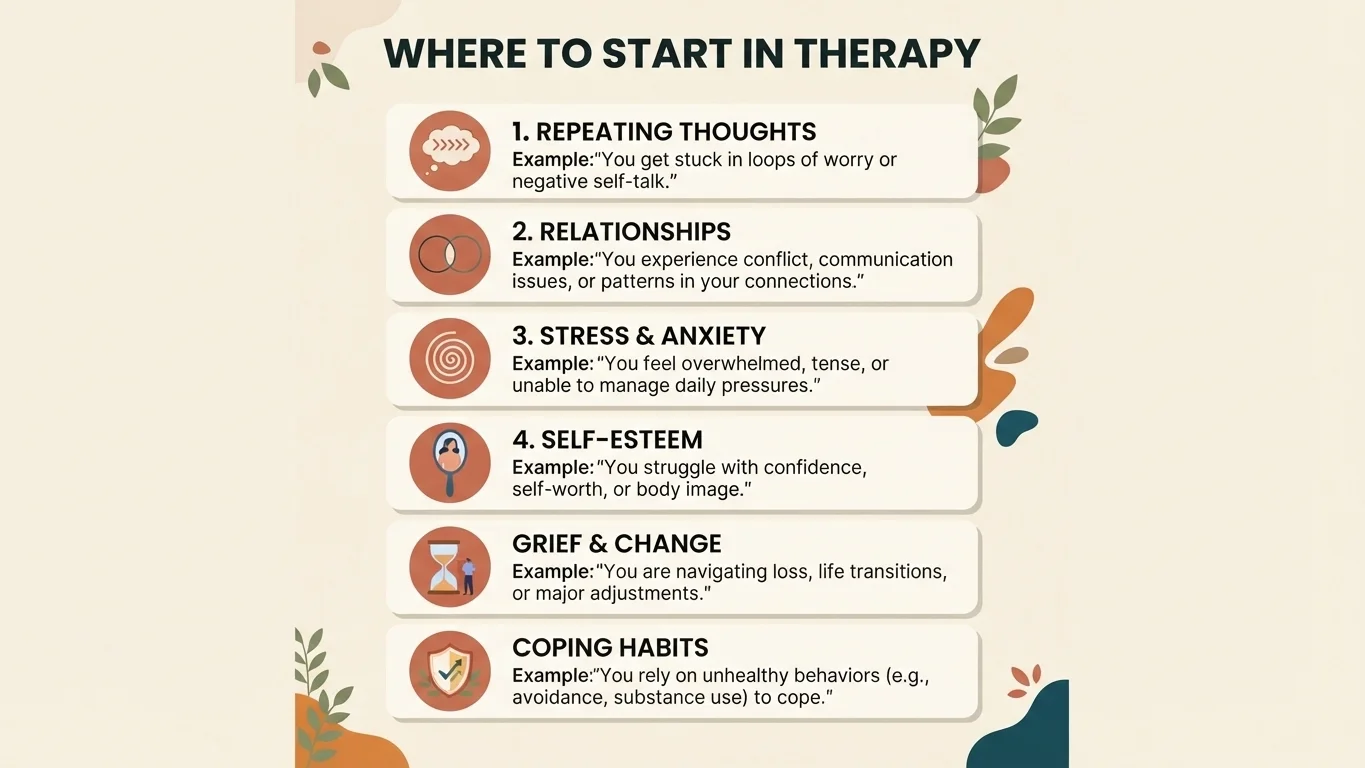
You do not have to begin with your deepest memory. In many sessions, the best place to start is what is happening now.
| Therapy topic | What you might discuss | Helpful way to begin |
| Current emotions | Anxiety, sadness, anger, guilt, loneliness, or numbness | “I have been feeling more anxious than usual.” |
| Repeating thoughts | Overthinking, self-criticism, fear, or unwanted thoughts | “I keep thinking about the same situation.” |
| Relationships | Conflict, trust, boundaries, loneliness, or people-pleasing | “I am having trouble setting limits with someone.” |
| Habits and patterns | Avoidance, procrastination, shutting down, or seeking reassurance | “I notice that I keep reacting the same way.” |
| Daily stress | Work, school, parenting, finances, or caregiving | “Most of my stress currently comes from work.” |
| Self-esteem | Confidence, identity, body image, or feeling inadequate | “I am very hard on myself.” |
| Grief and change | Loss, breakups, moving, retirement, or other transitions | “A recent change has been harder than I expected.” |
| Trauma or painful memories | Past experiences and how they affect you now | “Something from my past still affects how I feel.” |
| Coping habits | Isolation, substance use, overeating, scrolling, or overworking | “I am not sure my coping habits are helping me.” |
| Therapy itself | Feeling stuck, misunderstood, uncomfortable, or unsure of progress | “I am not sure whether therapy is working for me.” |
What to Discuss in Your First Session
In your first therapy session, start by explaining what led you to seek help and how you have been feeling lately. You can talk about anxiety, low mood, stress, relationship problems, sleep changes, trouble focusing, or any recent event that has been hard to manage. It is also helpful to explain how these concerns affect your work, school, relationships, or daily routine.
You can also share your personal history, past treatment, current medications, and what you hope to gain from therapy. You do not need to tell your entire story at once or have clear goals before the session begins. Simply being honest about what feels difficult, confusing, or uncomfortable gives your therapist a useful place to start.
What to Say When Your Mind Goes Blank
Feeling blank in therapy is common. It may happen because you are nervous, tired, avoiding something painful, or placing pressure on yourself to find the perfect topic.
Name what is happening. You can say, “My mind went blank,” “I had things to say before I arrived,” or “I do not know where to start today.”
The blank feeling may itself be useful. It can point to fear, discomfort, disconnection, or a belief that your concerns are not important enough.
Try one of these prompts:
- What feeling did I avoid this week?
- What event did I keep thinking about?
- When did I feel most like myself?
- What drained the most energy?
- What conversation am I rehearsing?
- What choice am I avoiding?
- What improved, even a little?
- What do I need help handling next?
A session does not fail because it starts slowly. Silence can become useful when you and your therapist stay curious about it.
How to Bring Up a Difficult or Embarrassing Topic
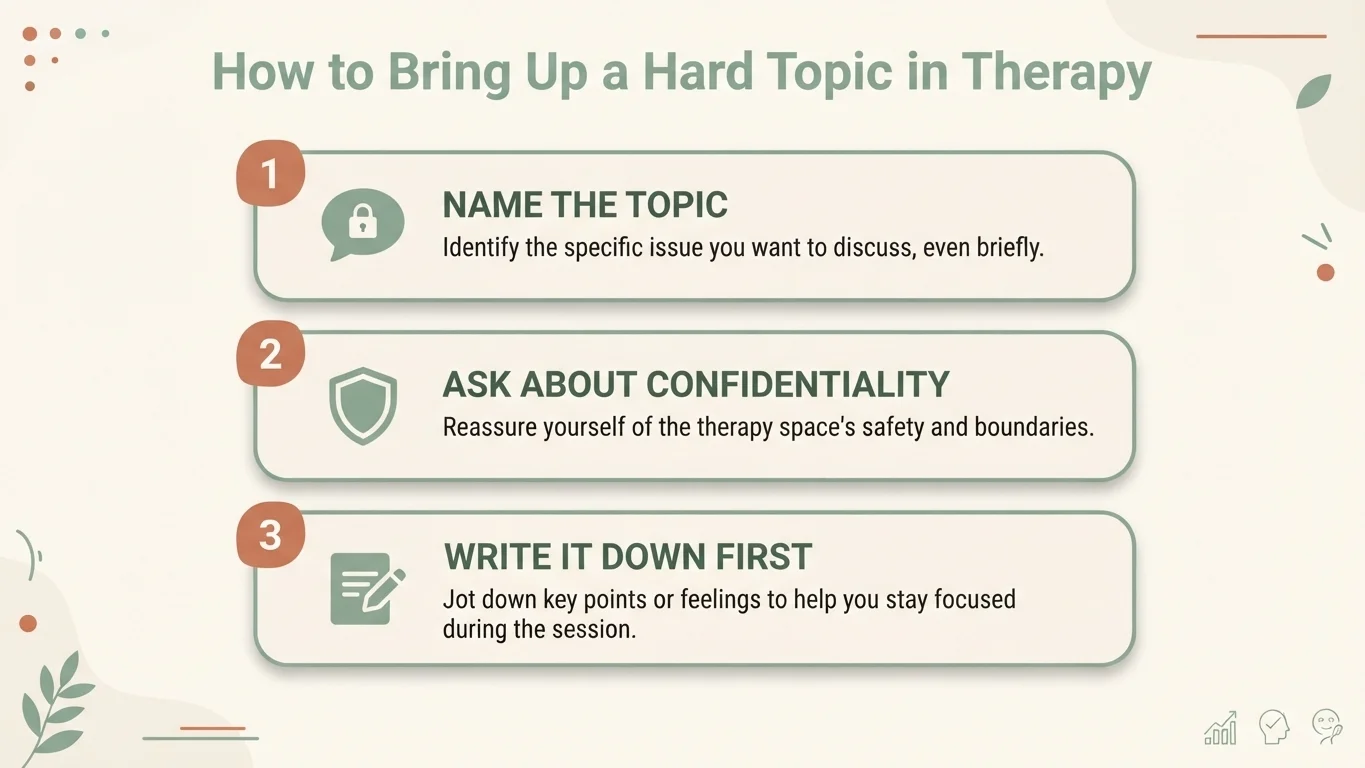
You do not have to begin with every detail. Start by naming the type of concern.
You might say, “There is something about my relationship that I feel ashamed to discuss,” or “I have thoughts that scare me, but I am afraid of being judged.”
Ask your therapist to explain confidentiality and its limits before you continue. Privacy rules can have exceptions involving immediate safety, suspected abuse, court orders, or other legal duties. The rules may vary based on age, location, and type of care.
Writing the topic in a note may help. You can read it aloud or hand it to the therapist. You can also ask to slow down if you start feeling overwhelmed.
Can I Talk About the Therapy Process Itself?
Yes. You can discuss how therapy feels and whether the approach is helping.
Tell your therapist if you feel misunderstood, judged, rushed, confused, or unable to connect. You may also ask for more structure, practical tools, clearer goals, or less silence.
Useful questions include:
- “What are we working toward?”
- “How will we know if I am making progress?”
- “Could we focus more on practical tools?”
- “I did not feel understood last session. Can we revisit it?”
Honest feedback may improve the work. It may also show that another provider or treatment style would be a better fit.
Do I Have to Tell My Therapist Everything?
No. You control what you share and when you share it. Therapy is often more useful when you are honest, but honesty does not mean telling your full story before you feel ready.
You can say that a topic exists without describing it in detail. You can also ask why a question matters before answering.
However, hiding important information may make it harder for a provider to understand your symptoms or safety needs. Be open about medication, substance use, severe mood changes, self-harm, thoughts of harming someone, or trouble caring for yourself.
If you are in immediate danger or unable to stay safe, contact local emergency services or go to the nearest emergency room. Routine therapy or psychiatry visits are not emergency care.
How to Prepare for a Therapy Session
Preparation can be simple. Before the session, write down one feeling, one event, one challenge, one positive change, and one question.
You may also track sleep, panic episodes, mood changes, medication effects, or major triggers when relevant. Bring accurate information, but do not pressure yourself to record everything.
At the end of the session, ask what to focus on before the next visit. One small action is often more useful than a long list.
Therapy, Psychiatry, or Both?
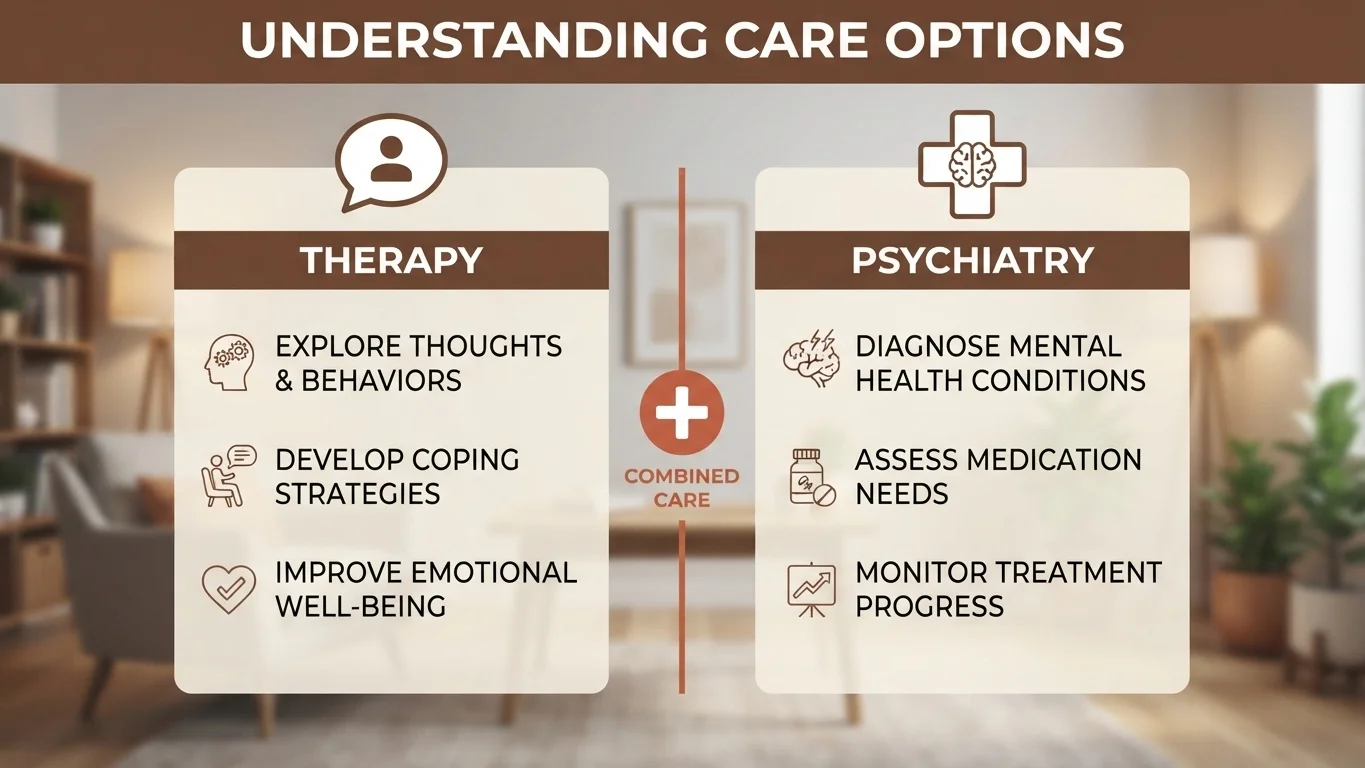
Therapy and psychiatry support mental health in different ways, and some people may benefit from both. The table below explains the main focus of each option and when it may be helpful.
| Type of care | Main focus | May be helpful when |
| Therapy | Emotions, thoughts, behaviors, relationships, and coping skills | You want to understand patterns, process experiences, or build healthier coping skills |
| Psychiatry | Mental health evaluation, diagnosis, medication, and symptom monitoring | Symptoms are severe, ongoing, or may benefit from medical assessment |
| Combined care | Therapy alongside psychiatric treatment | You need both practical emotional support and medical management |
Not Sure Which Type of Support You Need?
If you are still unsure whether therapy, medication, or a combination of both fits what you are dealing with, a consultation with Placid Psychiatry in Fullerton, CA can help you sort that out. Their team reviews your specific symptoms and history, then helps map out a plan that actually matches your situation instead of leaving you to guess.
You do not need a clear diagnosis or a fully formed explanation before reaching out. A consultation is meant to help you figure that part out, not something you need to have already sorted on your own. Reach out to schedule a consultation and take the next step toward the right kind of support.
Conclusion
There is no fixed answer to what belongs in a therapy session. Some weeks that means a specific event or a hard conversation you have been avoiding. Other weeks it means sitting with a feeling you cannot quite name yet, or admitting the current approach does not feel like it is working.
What matters more than the topic itself is showing up and being honest about what is actually going on, including the parts that feel small or uncomfortable to bring up. Those individual sessions, over time, build a clearer picture of your patterns and what genuinely helps.
Frequently Asked Questions
Do I need a specific topic, or can I just show up?
You can just show up without an agenda. Providers are used to working with whatever comes up in the moment, whether that’s a clear issue or just a vague sense something feels off. Arriving without a plan doesn’t slow the process down.
How long before sessions start feeling productive?
This varies by person and by what you’re working through, so there’s no fixed timeline. Some notice a shift within the first few sessions, while others take longer. If it’s been a while and something still feels off, raise it directly with your provider.
What if I say the wrong thing?
There isn’t really a wrong thing to bring up. Providers are trained to work with tangents, half-formed thoughts, and topics that don’t seem to connect to anything obvious. The goal is honesty, not a polished presentation.
Can family or friends join a session with me?
This depends on the type of care and the provider’s approach, so it isn’t a fixed yes or no. Some practices support joint or family sessions, while others focus strictly on individual care. It’s worth asking directly before assuming either way.
Is it normal to feel worse before feeling better?
For some people, yes, especially early on when working through something painful for the first time. This can bring temporary discomfort before relief. If it becomes persistent or unmanageable, tell your provider so the pace can adjust.
Is anything truly off-limits to bring up?
No ordinary topic is too small, strange, or embarrassing to raise. The one clear exception is an active safety emergency, which should go to emergency services rather than a routine appointment. Otherwise, providers are equipped to handle a wide range of subjects.