
Yes, transcranial magnetic stimulation (TMS) for anxiety may be right for you if medicine and therapy have not helped enough and you have no history of seizures. A 2016 trial in the British Journal of Psychiatry found real TMS lowered anxiety more than fake TMS in 25 adults with generalized anxiety disorder. The FDA has cleared TMS only for anxiety symptoms in adults with depression, not for anxiety alone. A psychiatric evaluation confirms whether TMS fits you. Anxiety can make daily life hard. Constant worry, a tense body, and poor sleep can make each day feel long. Some people do not get enough relief from medicine or talk therapy, so they start to look for other options. Placid Psychiatry in Fullerton, CA, explains how TMS works, what the research says, who may qualify, and what to expect. This way, you can talk with your provider using facts you can trust.
What Is TMS for Anxiety and How Does It Work?
TMS stands for transcranial magnetic stimulation. TMS is a treatment that uses short magnetic pulses to change how parts of the brain work. A small coil rests on your scalp. You stay awake, and there are no cuts and no medicine in the treatment itself. For anxiety, doctors often aim the pulses at the front part of the brain. This area helps you manage strong feelings and slow down worry. In people with anxiety, this area may not work as well as it should. TMS tries to help it work better.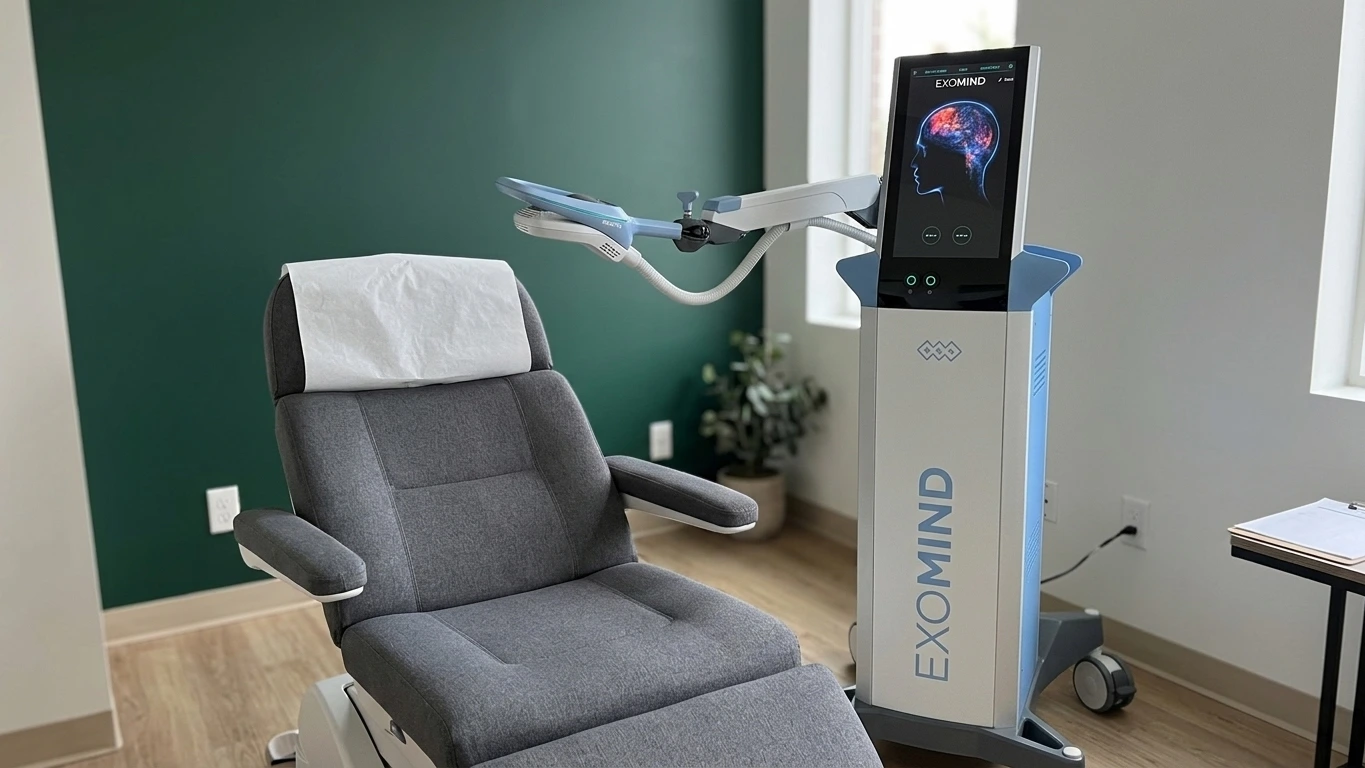
In a 2016 study in the British Journal of Psychiatry, Gretchen J. Diefenbach and her team at Hartford Hospital compared real TMS with fake TMS in 25 adults with generalized anxiety disorder. Real TMS led to larger drops in anxiety, worry, and depression symptoms. The authors call the study a pilot because it was small.
Tip: Notice which moments feel hardest to control, such as worry at night or snapping at people, and share them at your first visit.
Which Type of TMS Is Used for Anxiety?
Most studies on anxiety used repetitive TMS, which is often called TMS, with slow pulses aimed at the right front part of the brain. In TMS, the pulses repeat many times during each session. The speed of the pulses matters. Fast pulses make a brain area more active, and slow pulses calm it down. For depression, doctors usually use fast pulses on the left side of the front brain. For anxiety, studies have often tried slow pulses on the right side instead. Other types, such as deep TMS and theta burst, are used for some conditions. There is less research on them for anxiety so far. Your provider picks the type based on your diagnosis, your health, and the device the clinic has.
Does TMS Work for Anxiety? What the Research Says
Yes, early research shows TMS can lower anxiety in adults with generalized anxiety disorder. In a 2016 British Journal of Psychiatry trial, real TMS lowered anxiety more than fake TMS. A 2022 review of 6 studies also found large drops in anxiety scores. The studies are few and small, so doctors want more proof.
The First Trial in Generalized Anxiety Disorder
Before this trial, doctors only had one small test of TMS for anxiety, and it had no comparison group. So no one knew if TMS worked better than a fake TMS, which is a treatment with no real effect. This trial was the first to test that.
Research supports this. In a 2016 study in the British Journal of Psychiatry, Gretchen J. Diefenbach and her team at Hartford Hospital split 25 adults with generalized anxiety disorder into two groups. 13 adults got real TMS and 12 got fake TMS. Both groups felt better right after treatment. Three months later, 8 of the 13 adults (62%) who got real TMS still had a strong response. None of the 12 adults in the fake TMS group did.
Tip: When you read about a TMS study, check if it had a fake TMS group. That is the best way to tell real results from a placebo effect.
What the Review of 6 Studies Found
Yes, anxiety scores dropped more with TMS across 6 small studies. This was a review, which means the researchers did not test patients themselves. They searched for all the studies on TMS for generalized anxiety disorder, kept the ones that met clear rules, and combined the results. This gives a bigger picture than any one small study can. Even so, the authors say it is not enough to change how doctors treat anxiety yet.
Research supports this. In a 2022 review in the International Journal of Neuropsychopharmacology, Tapan K. Parikh and his team at Mayo Clinic combined 6 studies with 152 adults who had generalized anxiety disorder. 97 adults got TMS and 55 got fake TMS. TMS lowered anxiety scores by a large amount. But three of the 6 studies had no fake TMS group, so the result may look stronger than it is.
Tip: Ask your provider which studies they base their advice on and how big those studies were.
Is TMS FDA-Approved for Anxiety?
No, not for anxiety alone. The FDA has cleared two TMS systems to reduce anxiety symptoms in adults with depression: BrainsWay Deep TMS in August 2021 and Neuronetics NeuroStar in July 2022. This use is called anxious depression. Using TMS for other types of anxiety is called off-label use. That means a doctor uses a device in a way the FDA has not cleared. Your provider can tell you if that fits your case. 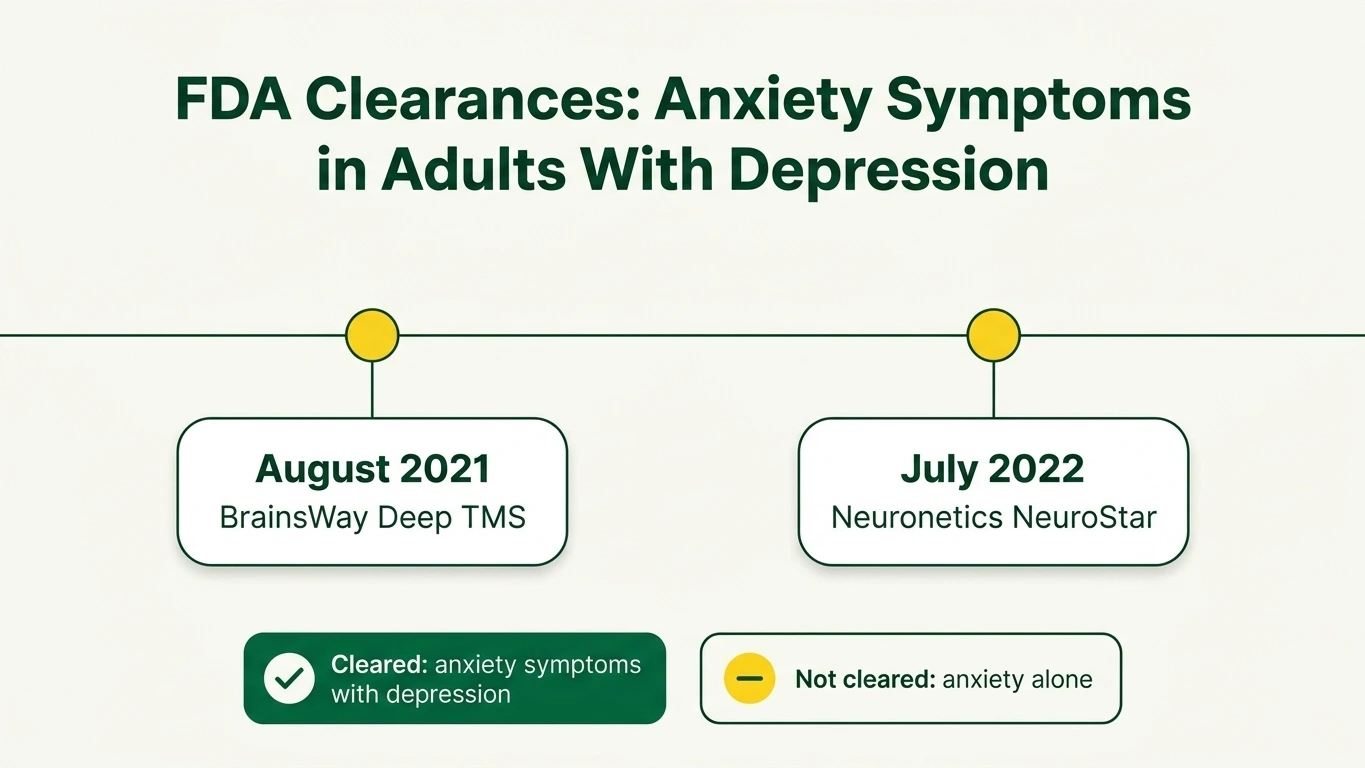
| Device | Maker | Clearance date | Cleared for |
| Deep TMS | BrainsWay | August 2021 | Anxiety symptoms in adults with depression |
| NeuroStar | Neuronetics | July 2022 | Anxiety symptoms in adults with major depressive disorder |
What Is the Difference Between Anxiety and Anxious Depression
Generalized anxiety disorder is constant worry that is hard to stop. Anxious depression is depression that comes with strong anxiety. The two can feel alike, but doctors plan care for them in different ways.
| What to compare | Generalized anxiety disorder | Anxious depression |
| What it is | Constant worry that is hard to stop | Depression that comes with strong anxiety |
| Main signs | Nonstop worry, a tense body, trouble relaxing | Low mood, low energy, loss of interest, plus worry and a tense body |
| How doctors often start | Medicine, talk therapy, or both | Care for depression, which may include TMS |
This matters for TMS. The FDA has cleared TMS for depression and for anxiety symptoms that come with depression. It has not cleared TMS for anxiety alone. If low mood is part of your story, depression treatment may be the right place to start.
Does TMS Work for Anxious Depression?
Yes, TMS is an FDA-cleared option for adults with depression who also have anxiety symptoms and did not improve on medicine. The FDA cleared BrainsWay Deep TMS in August 2021 and NeuroStar in July 2022 for anxiety symptoms in adults with depression. Treating depression can also reduce the anxiety that comes with it. Placid Psychiatry in Fullerton, CA, offers TMS Therapy with Exomind for depression. Many people with depression also feel anxious. So share both your mood and your anxiety at your first visit. This helps your provider plan care that fits you. FDA clearance applies to a specific device. Ask your provider which device the clinic uses and what the FDA has cleared it to treat.
Is TMS Therapy With Exomind Cleared for Anxiety?
The clinic describes Exomind as an FDA-cleared TMS option for depression. The FDA clearances for anxiety symptoms in adults with depression are for two other systems: BrainsWay Deep TMS in August 2021 and NeuroStar in July 2022. FDA clearance is given for each device, so one device’s clearance does not carry over to another.
That does not mean Exomind has no value if you also feel anxious. Many people with depression have anxiety, and treating depression can ease it for some people. But you should know exactly what a device is cleared to treat before you start. Ask your provider how they will track your anxiety during the course.
How Does TMS Compare With Medicine and Therapy for Anxiety?
Medicine and talk therapy are usually the first choices for anxiety. TMS is more often tried when those two have not helped enough. You can read about your anxiety treatment options before you decide.
| Option | What it is | When it is often used | What to know |
| Medicine | Daily pills that change brain chemicals | Often a first choice | Helps many people, but not everyone |
| Talk therapy | Sessions that teach skills to manage worry | Often a first choice | Skills can stay with you after sessions end |
| TMS | Magnetic pulses to the brain, no pills | When other care has not helped enough | Not cleared by the FDA for anxiety alone |
Are You a Good Candidate for TMS for Anxiety?
Yes, TMS may be right for you if medicine and therapy have not helped enough and your provider finds no safety concerns. Only a full psychiatric evaluation can tell you for sure.
Who May Benefit
TMS may be worth a talk if you have anxiety, or depression with anxiety, and other care did not give enough relief. It may also fit if you want a treatment without daily pills. You also need to be able to get many short visits.
Who Should Not Get TMS
Your provider will check for things that can make TMS unsafe. These include a history of seizures and certain metal implants in the head. Share your full health history, your medicines, and any past head injuries at your evaluation. If TMS is not safe for you, other treatments can still help.
What to Expect From TMS Sessions for Anxiety
A TMS course takes many short visits over several weeks. Each visit is a session. You sit in a chair, stay awake, and the coil rests on your head while the pulses run. The number of sessions depends on the method your clinic uses. Some methods, such as TMS Therapy with Exomind, use fewer sessions than traditional TMS. Ask your provider how many sessions your plan has and how long each visit takes. A long schedule can be hard to keep up. Plan your work and travel before you start so you do not miss visits. Results differ from person to person, so ask what to expect in your own case.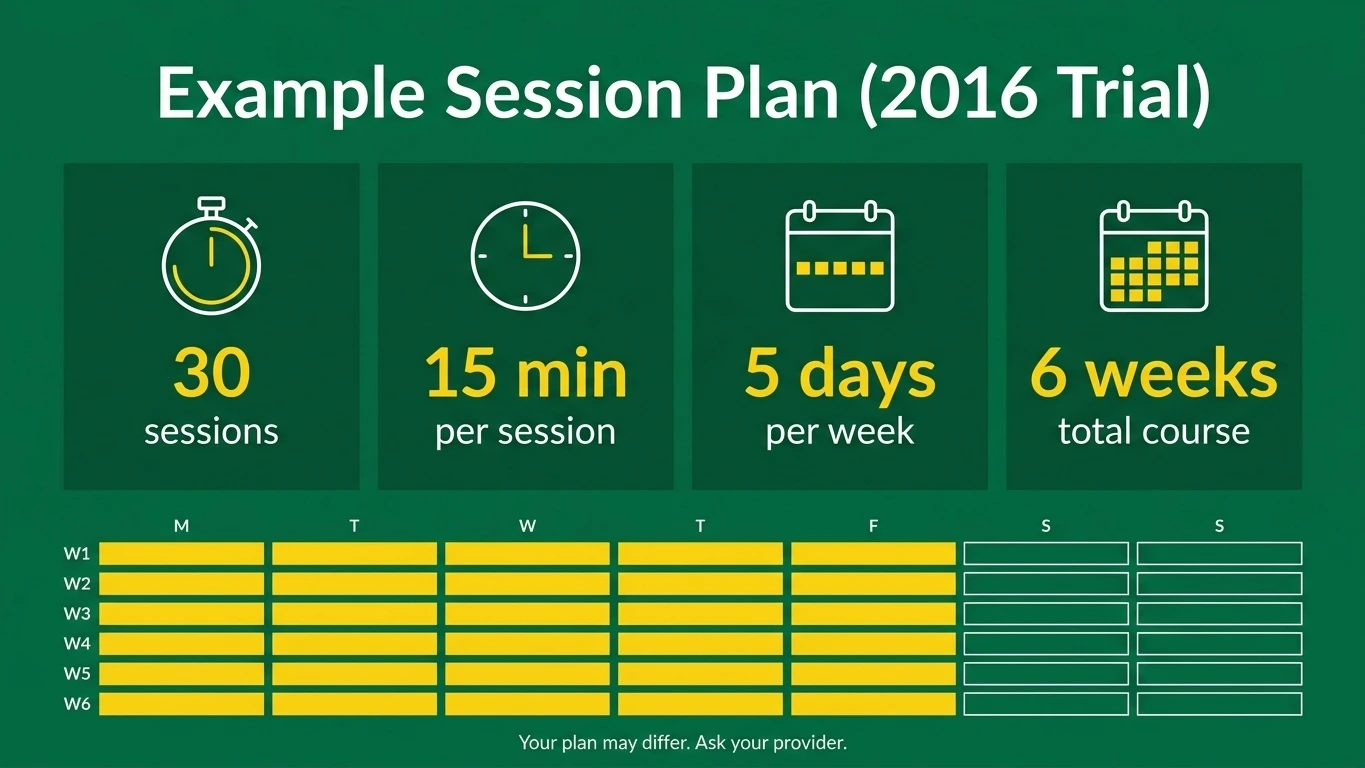
| Protocol | Sessions | Time Per Session | Schedule |
| Low-frequency right-side TMS (2016 trial) | 30 | 15 minutes | 5 days a week for 6 weeks |
| Open trial (Bystritsky 2008) | 6 | Not reported | 2 days a week for 3 weeks |
| Deep TMS (ADAA) | About 20 to 30 | 20 minutes | Daily for 4 to 6 weeks |
| 6 GAD studies (Parikh 2022) | 6 to 36 | Varies | Varies |
How Soon Does TMS Work for Anxiety?
Several weeks is the usual time frame in studies. Most research on TMS for anxiety checked results after a full course of treatment, so there is no firm answer yet on how soon it starts to help. Some people may notice small changes during the course, such as less tension or better sleep. Others may notice a change later, and some may not feel better at all. Results differ from person to person. Your provider can check your progress as the weeks go on and change your plan if needed.
Tip: Write a short weekly note about your worry, sleep, and mood. It helps you and your provider see small changes.
Does Insurance Cover TMS for Anxiety?
Not always. Coverage depends on your plan and your diagnosis. Many insurance plans cover TMS for depression when other treatments have not helped. Coverage for anxiety alone is less likely, because the FDA has not cleared TMS for it. If your diagnosis is depression with anxiety symptoms, the rules for your plan may be different. The best way to find out is to call your insurance company before you start. Ask whether TMS is covered for your diagnosis, whether you need prior approval, whether you must try medicines first, and how many sessions your plan pays for. Also ask what you would pay out of pocket for each visit. You can also ask the clinic if it can check your benefits for you. This helps you know the cost before the first session.
TMS for Anxiety Side Effects and Safety
TMS is usually well tolerated. The most common side effects are mild pain or tingling where the coil touches your head, a headache, and a twitching feeling in the face. These often ease as the sessions go on. Serious problems are rare. A seizure is the main risk, which is why providers ask about your health history before the first session. Call the clinic right away if you feel unwell during or after a session. Bring a list of your medicines to your first visit. It helps your provider check that TMS is safe for you.
Can TMS Make Anxiety Worse?
Yes, anxiety can rise for a short time in some people during TMS. Let your care team know right away if your anxiety goes up. Your provider can adjust your plan.
Conclusion
TMS for anxiety is a promising option, but the research is still early. Small studies show it can lower anxiety in people with generalized anxiety disorder. The FDA has also cleared two TMS system for anxiety symptoms that come with depression. TMS may fit you if medicine and therapy have not helped enough and you have no safety concerns, such as a history of seizures. The best next step is to talk with a licensed provider about your health and your goals.
Next Steps and When to Get Help
Only a licensed provider can tell you if TMS fits your needs. At Placid Psychiatry in Fullerton, CA, the first step is a psychiatric evaluation. You can also ask about TMS Therapy with Exomind if depression is part of what you feel. When you are ready, you can book a visit online, by phone, or through the contact form.
If you are in crisis, call or text 988, or call 911. This page is not for emergencies.
Frequently Asked Questions
Can TMS Cure Anxiety?
No. No study has shown that TMS cures anxiety. Research so far points to lower symptoms in some adults, and results differ from person to person. Because long-term results are still unknown, doctors treat TMS as one part of a care plan that may also include medicine or talk therapy.
How Long Do TMS Results for Anxiety Last?
Nobody knows yet. The 2016 British Journal of Psychiatry trial followed adults for 3 months, so no study I checked shows benefits beyond that point. Ask your provider whether follow-up visits or extra sessions are an option if symptoms return, and which signs mean you should book a check.
Does TMS Work for Panic Disorder or Social Anxiety?
No, not enough research exists yet. Most studies so far focus on generalized anxiety disorder, so there is little evidence for panic disorder or social anxiety disorder. If you have one of these conditions, ask your provider which treatments have stronger proof first and whether a research study near you is enrolling.
Can I Do TMS While Taking Anxiety Medicine?
Yes, if your provider finds it safe. Your provider reviews your current medicines and health history before deciding on a plan. Never stop or change a dose on your own, because stopping suddenly can cause problems of its own. Ask your provider if any of your medicines affect your TMS plan.
Can I Go Back to Work After a TMS Session?
Yes, you can return to work or school after a session, since TMS needs no sedation. Plan for the travel and visit time on each treatment day. If a headache or dizziness follows a session, ask your provider before you drive.