
ADD and ADHD are not two different conditions, they are the same thing under two different names. ADD (Attention Deficit Disorder) was the official medical term used before 1987. Today, doctors use only ADHD (Attention Deficit Hyperactivity Disorder) to describe all presentations of the condition, including the type that used to be called ADD.
The name changed in 1987 when the American Psychiatric Association updated the DSM and merged inattention and hyperactivity into one diagnosis, ADHD, with three possible presentations: inattentive, hyperactive-impulsive, and combined. ADD is still used casually today, usually by people trying to describe someone who is inattentive but not hyperactive, but that distinction already exists inside the modern ADHD framework, so ADD is no longer a separate or medically recognized diagnosis.
If your child daydreams in class, struggles to finish homework, or seems easily distracted, or if you’ve wondered whether you had undiagnosed ADD or ADHD as a child, this guide breaks down the three types of ADHD, how symptoms show up differently in kids versus adults, what causes it, and how it’s diagnosed and treated. If you’re in Fullerton, CA and want a proper evaluation, our team at Placid Psychiatry can help you get clear answers.
ADD vs ADHD at a Glance
| Stands For | Status Today | |
|---|---|---|
| ADHD | Attention Deficit Hyperactivity Disorder | Current official diagnosis (DSM-5) |
| ADD | Attention Deficit Disorder | Outdated term, retired in 1987, now called “ADHD, Predominantly Inattentive Presentation” |
In short: ADD and ADHD describe the same underlying condition. ADD was simply the name used before 1987. If you were diagnosed with ADD as a child, you would receive an ADHD diagnosis today, nothing about the condition changed, only the terminology.
What Is ADHD?
ADHD stands for Attention Deficit Hyperactivity Disorder. It is a neurodevelopmental condition, meaning it originates in how the brain develops and functions rather than being caused by the environment. ADHD affects the parts of the brain responsible for executive function. This includes things like planning, organizing, managing emotions, and sustaining focus on tasks.
Because these are foundational skills that touch almost every area of life, ADHD can show up in school performance, relationships, work productivity, and emotional regulation. It is one of the most commonly diagnosed neurodevelopmental disorders in children, but it is equally common in adults.
What Is ADD?
ADD stands for Attention Deficit Disorder. It was the official medical term used to describe attention-related difficulties before 1987. Back then, the condition was listed in the third edition of the Diagnostic and Statistical Manual of Mental Disorders, known as the DSM-III, and it came in two versions: ADD with hyperactivity and ADD without hyperactivity.
In 1987, the American Psychiatric Association updated the DSM and replaced ADD with ADHD as the single official diagnosis. The change was made because research showed that inattention and hyperactivity were not two separate conditions but rather different expressions of the same underlying neurodevelopmental disorder.
Is ADD Considered a Mental Illness?
ADD (now called ADHD) is not classified as a “mental illness” in the clinical sense, it’s classified as a neurodevelopmental disorder. That distinction matters. Mental illnesses, like depression or anxiety, typically involve changes in mood, thinking, or behavior that can develop at any point in life, often in response to stress, trauma, or biological changes. Neurodevelopmental disorders, by contrast, originate from differences in how the brain develops early in life, the wiring is different from the start, not something that “sets in” later.
That said, ADHD is listed in the DSM-5 (the same diagnostic manual used for mental illnesses), which is part of why the two get lumped together in everyday language. Clinically, though, ADHD sits alongside conditions like autism spectrum disorder, not alongside major depressive disorder. It’s also worth noting that having ADHD does increase the risk of developing a co-occurring mental illness, such as anxiety or depression, especially when symptoms go unmanaged for years. So while ADD/ADHD itself isn’t a mental illness, it’s a legitimate medical diagnosis that deserves the same level of care and treatment.
ADD vs ADHD: The Key Difference Explained
ADD is an outdated term, while ADHD is the current medical diagnosis that includes inattentive, hyperactive-impulsive, and combined types.
ADD Is an Outdated Term
ADD is simply the old name for what is now called ADHD. Before 1987, doctors used ADD to describe children who struggled with attention and focus. Some of those children were also hyperactive, and some were not. The condition itself did not change. Only the label did.
Why the Name Was Updated
In 1987, the American Psychiatric Association updated the DSM and replaced ADD with ADHD as the single official diagnosis. The change happened because research showed that inattention and hyperactivity were not two separate conditions. Bringing everything under one name made diagnosis more accurate and treatment more consistent.
ADHD Is the Current Official Diagnosis
Today, ADHD is the only medically recognized term. It covers all presentations of the condition, whether a person is inattentive, hyperactive, impulsive, or a combination of all three. If someone was diagnosed with ADD decades ago, they would receive an ADHD diagnosis under today’s standards. Nothing about their condition changed. The medical language simply caught up with science.
Why People Still Use ADD
The reason ADD is still so common comes down to habit and misunderstanding. Many people use ADD to describe someone who is quiet and distracted, assuming ADHD only means hyperactive. But that distinction is already built into the ADHD presentation system. In any clinical setting, any doctor’s office, or any formal evaluation, the correct and current term is always ADHD.
Types of ADHD

Under current DSM-5 guidelines, ADHD is divided into three presentations. Understanding these presentations is the key to understanding why some people still think ADD and ADHD are different things.
Inattentive Type (Formerly Called ADD)
This is the presentation that most people are thinking of when they say ADD. People with inattentive ADHD have significant difficulty staying focused, following through on tasks, and staying organized. They are easily distracted, frequently forget things, lose items often, and tend to avoid tasks that require sustained mental effort.
What makes this presentation easy to miss is that it does not come with obvious behavioral disruption. A child with inattentive ADHD may sit quietly in class, stare out the window, and appear calm. Teachers and parents may describe them as daydreamy or unmotivated, not realizing that the child is genuinely struggling with attention regulation.
Hyperactive-Impulsive Type
This presentation involves high levels of physical restlessness and difficulty controlling impulses. A person with hyperactive-impulsive ADHD may fidget constantly, get up from their seat at inappropriate times, talk excessively, blurt out answers before questions are finished, and struggle to wait their turn.
This is the presentation most people picture when they hear the word ADHD. The behaviors are more outwardly visible, which means they often get noticed and diagnosed earlier. However, the visible energy can sometimes mask the underlying difficulties with impulse control and emotional regulation that are equally significant parts of the condition.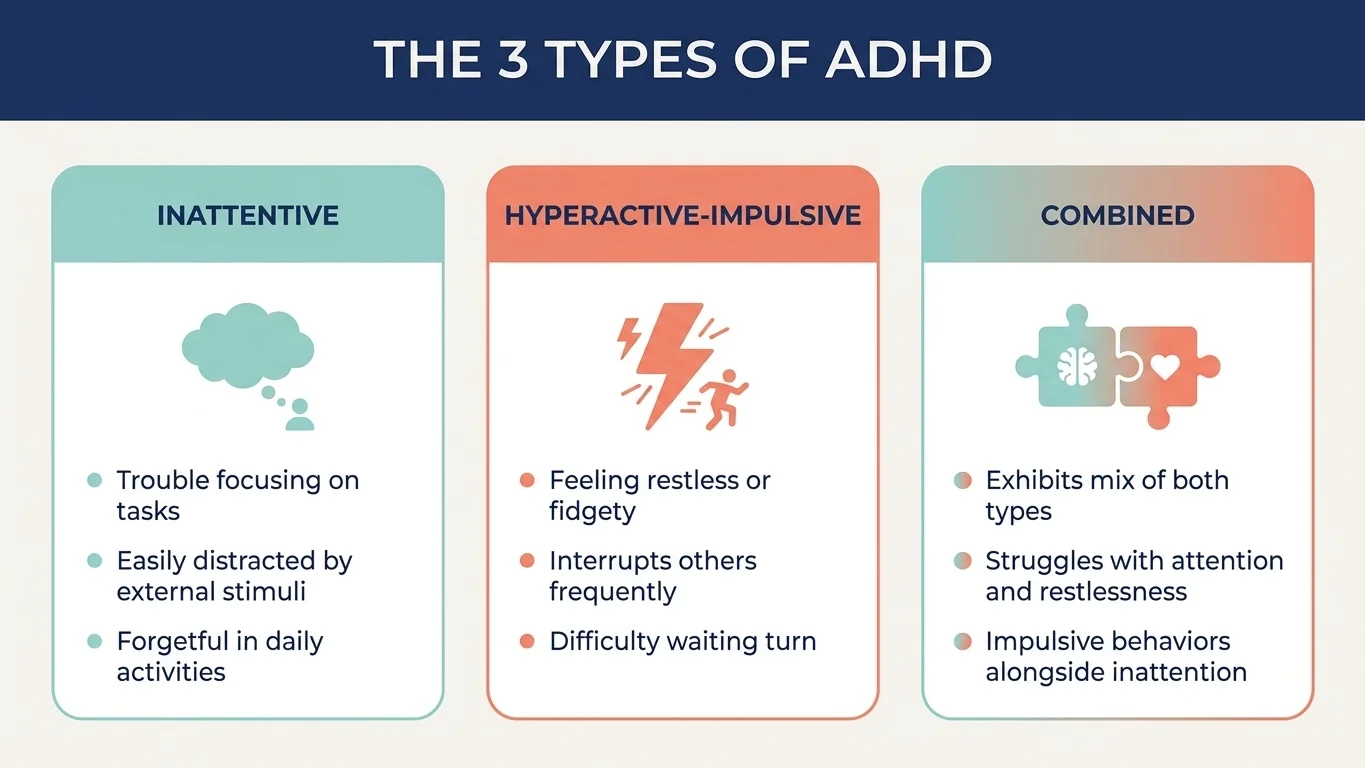
Combined Type
This is the most commonly diagnosed presentation of ADHD. It includes significant symptoms from both the inattentive and hyperactive-impulsive categories. A person with combined type ADHD struggles both with staying focused and with controlling their activity level and impulses. Because both sets of symptoms are present, the impact on daily functioning is often broader and more complex.
Symptoms of ADHD
ADHD symptoms usually include trouble focusing, restlessness, and acting without thinking, and they can look different in each person.
Common Inattentive Symptoms
People with inattentive ADHD often have trouble staying focused on tasks, especially ones that are repetitive or require prolonged mental effort. Disorganization shows up in their workspace, their schedule, and their thought process. They may also have difficulty listening when spoken to directly, not because they do not care, but because their brain struggles to hold onto the information.
Hyperactivity Symptoms
Hyperactivity looks different depending on age. In younger children, it often means constant movement, running, climbing, and an inability to play quietly. In older children and adults, it may show up as restlessness, an inability to sit still for long periods, or a constant feeling of being driven by a motor. Excessive talking is also a hallmark symptom, along with difficulty engaging in quiet activities.
Impulsivity Symptoms
Impulsivity means acting before thinking. In children, this can look like grabbing things from others, pushing ahead in line, or taking risks on the playground. In adults, it may show up as impulsive spending, abrupt career changes, or difficulty maintaining relationships.
ADD Symptoms vs. ADHD Symptoms, Side by Side
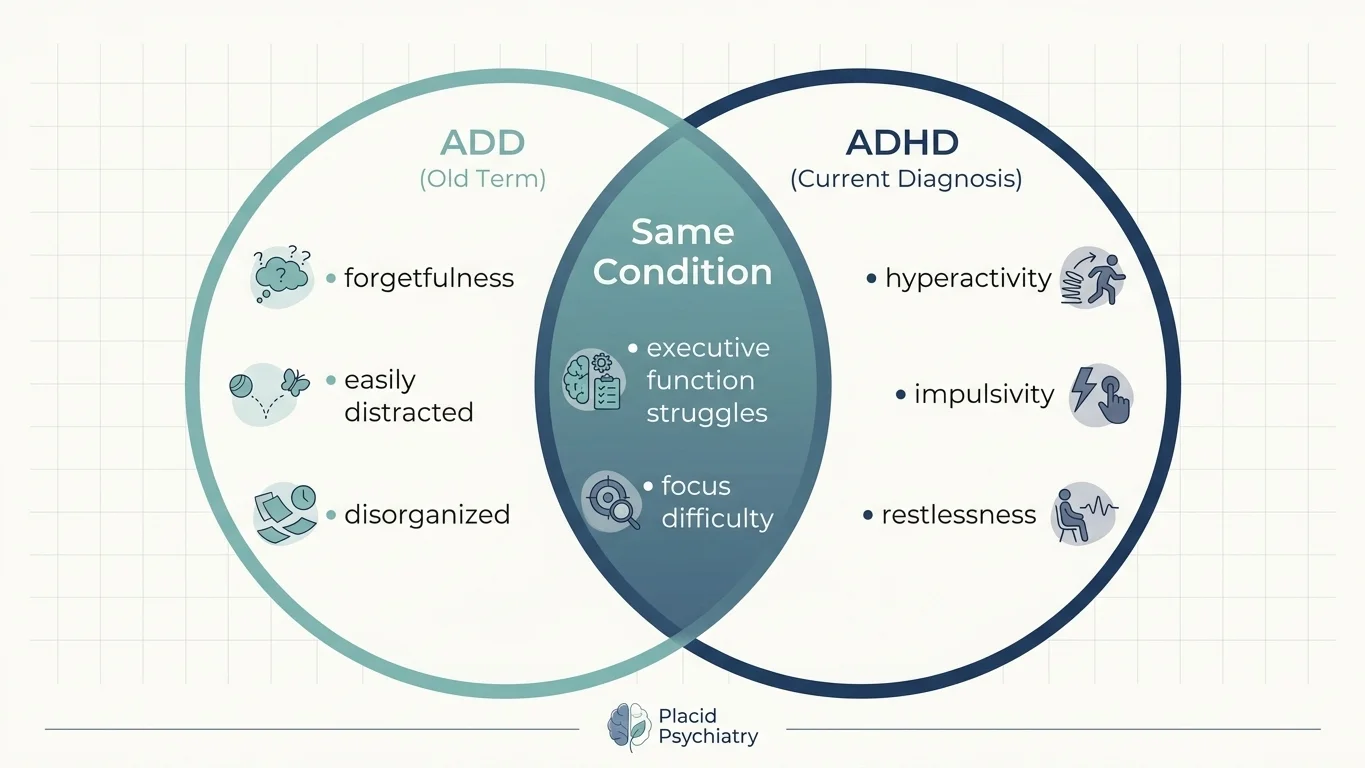
Since “ADD” refers specifically to the inattentive presentation, comparing “ADD symptoms” to “ADHD symptoms” really means comparing the inattentive presentation to the hyperactive-impulsive and combined presentations. People with ADD-type (inattentive) symptoms tend to struggle quietly, losing focus, forgetting tasks, misplacing items, without obvious disruptive behavior. People with hyperactive or combined-type ADHD show more outwardly visible symptoms: fidgeting, interrupting, difficulty staying seated. This is exactly why inattentive ADHD (formerly ADD) is diagnosed later and more often missed, especially in girls and quieter children, there’s no behavioral “red flag” prompting a teacher or parent to seek an evaluation.
Why ADD Is Still Commonly Used
The term ADD has been out of official medical use since 1987, yet it is still everywhere. There are a few reasons for this.
First, the change happened gradually. In the early years after the DSM was updated, many doctors, schools, and mental health professionals continued using ADD out of habit.
Second, many people use ADD specifically to describe the inattentive presentation of ADHD because they want to distinguish it from the hyperactive type. The logic makes sense on the surface. Someone says their child has ADD to signal that they are not hyperactive, just inattentive.
Third, there is still widespread misunderstanding about what ADHD actually is. Many people assume ADHD means hyperactive by definition, so they reach for ADD when they want to describe someone who is quiet and distracted.
How ADHD Is Diagnosed

There is no blood test or brain scan that diagnoses ADHD. The diagnosis is clinical, meaning it is based on a thorough evaluation of symptoms, behavior patterns, and how those symptoms affect daily functioning across multiple settings. A proper evaluation typically involves detailed interviews with the patient and, in the case of children, parents and teachers.
Standardized rating scales are used to measure the severity and frequency of symptoms. The DSM-5 guidelines are the standard framework used for diagnosis in the United States. A complete evaluation also rules out other conditions that can cause similar symptoms, such as anxiety, depression, learning disabilities, or sleep disorders.
Causes and Risk Factors of ADHD
ADHD is not caused by bad parenting, too much screen time, or eating too much sugar. These are common myths that have been thoroughly debunked by research.
The strongest evidence points to genetics as the primary driver. ADHD runs in families. If a parent has ADHD, a child has a significantly higher chance of having it too. Studies of twins show that ADHD is among the most heritable of all psychiatric conditions.
Brain structure and function also play a role. Research shows that certain areas of the brain, particularly those involved in executive function and impulse control, develop differently in people with ADHD. These differences are not the result of damage.
Environmental factors can also increase risk. Low birth weight, premature birth, prenatal exposure to tobacco or alcohol, and early childhood exposure to lead have all been linked to a higher likelihood of ADHD. However, these factors do not cause ADHD on their own.
ADHD in Children vs Adults
ADHD looks different depending on age. In young children, hyperactivity and impulsivity are usually the most visible symptoms. As children grow older, the physical restlessness often quiets down, but inattention, disorganization, and emotional dysregulation become more of a daily challenge.
In adults, ADHD typically shows up as trouble managing time, difficulty following through on commitments, and a pattern of underperforming despite having the intelligence. Many adults are diagnosed for the first time in their thirties or forties, often after a child in the family receives a diagnosis first. Women are particularly likely to be diagnosed late because inattentive symptoms are easier to overlook and mask over time.
Treatment Options for ADHD
ADHD is highly treatable. Most people respond well to a combination of approaches tailored to their specific presentation and needs.
Medication Options
Stimulant medications are the most commonly prescribed treatment for ADHD and are effective for the majority of people. They work by increasing the availability of dopamine and norepinephrine in the brain, which improves focus, impulse control, and executive function. Non-stimulant medications are also available for people who do not respond well to stimulants or who have conditions that make stimulant use complicated.
Behavioral Therapy
Cognitive behavioral therapy, commonly called CBT, is particularly effective for ADHD. It helps people identify unhelpful thought patterns, build organizational systems, and develop coping strategies for managing symptoms. For children, parent training and classroom behavioral interventions are also important parts of treatment.
Lifestyle Management
Sleep, diet, exercise, and routine all have a meaningful impact on ADHD symptoms. Regular physical activity has been shown to improve focus and reduce impulsivity. Consistent sleep schedules help regulate the brain’s executive function systems. Breaking tasks into smaller steps, using visual schedules, and setting timers are practical strategies that many people with ADHD find helpful for managing daily life.
Can ADHD Be Cured?
ADHD cannot be cured. It is a lifelong neurodevelopmental condition. However, this does not mean the symptoms cannot be managed effectively. Many people with ADHD lead highly successful, productive, and fulfilling lives with the right support and strategies in place.
Symptoms often shift over time. The hyperactivity that was prominent in childhood may quiet down in adulthood, while challenges with organization and time management may become more significant. Treatment plans should evolve accordingly.
When to See a Doctor
If you notice ongoing patterns of inattention, hyperactivity, or impulsivity that are affecting school, work, or daily relationships, it is worth speaking with a doctor or mental health professional. The same applies to adults who recognize these patterns in themselves.
Early diagnosis leads to earlier support, and earlier support leads to better outcomes in education, relationships, and mental health. ADHD that goes unrecognized can lead to low self-esteem, anxiety, and a pattern of underachievement that has nothing to do with intelligence. Do not wait and hope the symptoms resolve on their own.
Get a Proper ADHD Evaluation at Placid Psychiatry in Fullerton, CA
Understanding whether you or your child has ADHD is the first and most important step toward getting the right support. At Placid Psychiatry in Fullerton, CA, our psychiatric specialists provide comprehensive ADHD evaluations for both adults and adolescents, with treatment plans built around your specific symptoms, challenges, and goals.
Whether it’s inattentive, hyperactive, or combined ADHD, we first understand how it affects your daily life before suggesting any treatment. Do not wait for symptoms to get harder to manage. Book your appointment today and take the first step toward a clearer, more supported life.
Conclusion
ADD and ADHD describe the same underlying condition, ADD is simply the term doctors used before 1987, and ADHD is the diagnosis that replaced it and is still used today. ADHD now covers three presentations: inattentive (what most people still call ADD), hyperactive-impulsive, and combined type, each with its own pattern of symptoms that can look very different from one person to the next.
There’s no blood test or scan that confirms ADHD, diagnosis comes from a clinical evaluation that looks at behavior, history, and functioning across multiple settings, guided by DSM-5 criteria. While genetics are the strongest known risk factor, ADHD is not caused by parenting, screen time, or diet, and it cannot be “cured”, but with the right combination of medication, therapy, and lifestyle strategies, it can be managed effectively at any age, whether it’s newly noticed in a child or recognized for the first time in adulthood.
If these patterns sound familiar, in yourself or your child, the next step isn’t guessing which label applies. It’s getting a proper evaluation. Placid Psychiatry in Fullerton, CA offers comprehensive ADHD evaluations for children and adults, with treatment plans built around your specific symptoms and goals. Book your appointment today and get the clarity you’ve been looking for.
Frequently Asked Questions
Is ADD the same as ADHD?
ADD is simply an older name for what is now officially called ADHD. The term ADD was used in medical practice until 1987, when the DSM was updated and ADHD became the standard diagnosis. Today, all presentations of the condition fall under the ADHD umbrella.
Why was ADD removed from diagnosis?
ADD was replaced because researchers and clinicians determined that inattention and hyperactivity were not separate disorders but different expressions of the same condition. Bringing them together under one diagnosis with distinct presentations created a more accurate and useful framework for diagnosis and treatment.
Can adults have ADHD?
ADHD is a lifelong condition. Many adults have had it since childhood but were never diagnosed. Adult ADHD often looks different from childhood ADHD, with less visible hyperactivity and more prominent difficulties with organization, time management, and emotional regulation.
What are the first signs of ADHD?
Early signs often include difficulty staying seated, excessive talking, trouble following multi-step instructions, frequent careless mistakes, losing things constantly, and difficulty waiting for a turn. In quieter children, the signs may be more subtle, such as daydreaming, appearing not to listen, and struggling to finish tasks.
Is ADHD genetic?
Genetics play a major role in ADHD. It runs strongly in families, and studies consistently show it is one of the most heritable neurodevelopmental conditions. However, genetics alone do not determine outcome. Environment, support, and treatment all have a significant influence on how the condition affects a person’s life.