
You can stop shaking from anxiety by calming the stress response behind it, and a few simple physical techniques can do that within minutes. Trembling hands or a shaky voice can make anxiety feel even harder to hide, so this guide starts with a 2-minute plan you can use right now.
At Placid Psychiatry in Fullerton, CA, we help adults and teens learn how to stop shaking from anxiety and why it keeps coming back. Below, you’ll find 6 techniques, what the research actually shows, and how to tell an anxiety tremor from a neurological one.
Trembling During an Anxiety Spike? Try This 2-Minute Plan
When anxiety makes you tremble, use these 4 steps in order. Together they take about 2 minutes, and you can stop at any step once the shaking feels manageable.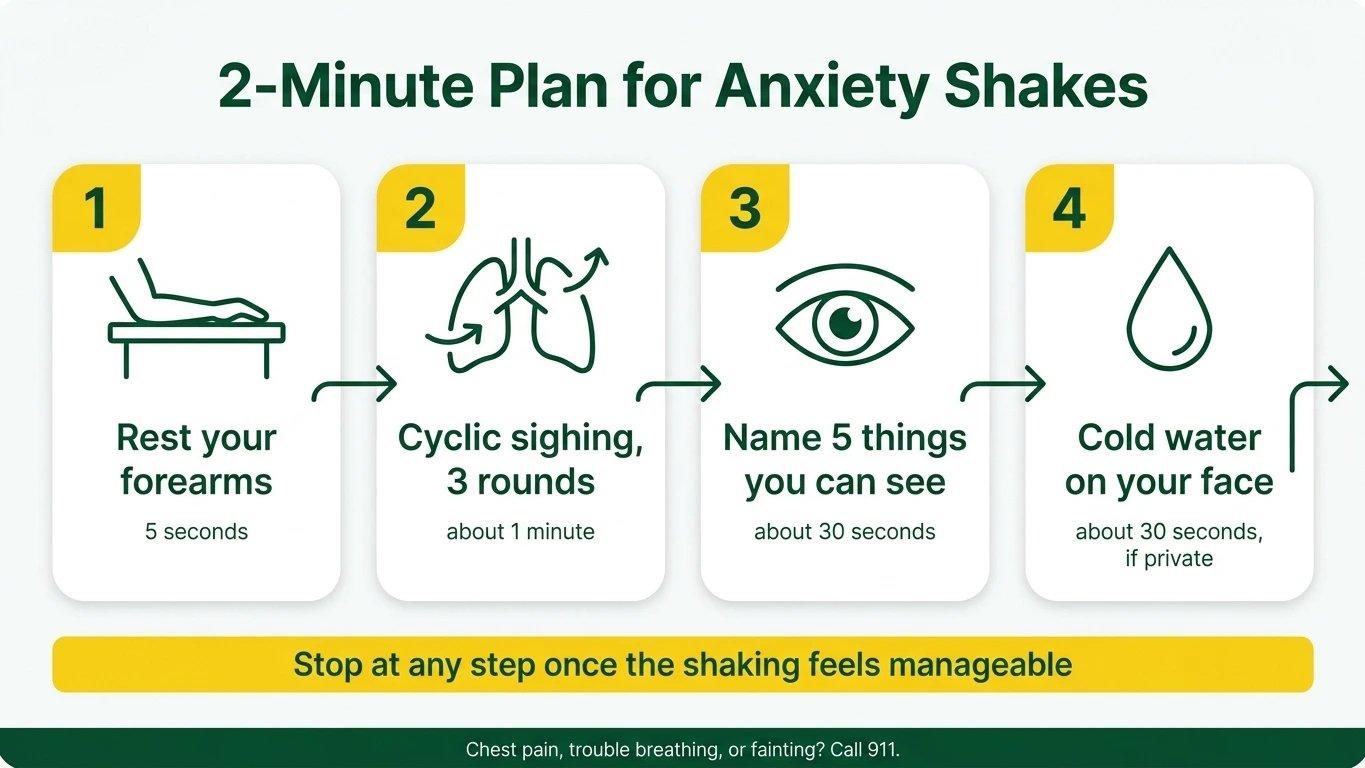
- Rest your forearms on a table or your thighs for about 5 seconds.
- Do 3 rounds of cyclic sighing, which takes about 1 minute.
- Name 5 things you can see for about 30 seconds.
- Still shaking hard and somewhere private? Use cold water on your face for about 30 seconds.
Each step gives your body something to do besides shake. If the trembling comes with chest pain, trouble breathing, or fainting, skip the plan and call 911.
6 Ways to Calm Anxiety Shakes Wherever You Are
These 6 techniques need no special tools and take from a few seconds to 10 minutes. Some work quietly in public, and others suit home.
1. Try Cyclic Sighing
Cyclic sighing is a double inhale through your nose followed by a long exhale through your mouth. Breathe in until your lungs feel full, take 1 more short sip of air, then let it all out slowly, and repeat for 1 to 5 minutes. If you feel lightheaded, make the inhales smaller. Learn this one first, because nobody around you can tell you are doing it.
2. Try Progressive Muscle Relaxation
Progressive muscle relaxation (PMR) means tensing a muscle group for 5 seconds and then letting it go for 10. Make tight fists, lift your shoulders toward your ears, and press your feet into the floor, releasing each one before moving to the next. Repeat the round 2 or 3 times, and skip any area that hurts or has an injury.
3. Use Cold Water to Calm Your Body
Holding a cold, wet cloth over your eyes and cheeks for about 30 seconds triggers the diving reflex, a built-in response that slows your heart rate. A slower heart rate helps the rest of your stress response settle, and shaking often eases with it. Splashing cold water on your face works too. Ask your doctor first if you have a heart condition or a history of fainting, and skip ice baths and long breath-holds.
4. Support Your Arms to Ease Visible Tremors

Trying to force your hands still usually adds tension, so give your arms support instead. Lay your forearms on a desk, an armrest, or your thighs, and hold a mug with both hands. This removes the load behind a postural tremor, the shaking that shows up when you hold your arms out.
5. Take a Short Walk to Release Nervous Tension
A brisk 5- to 10-minute walk uses up nervous energy. Swing your arms and keep a pace where you can still talk. If the shaking feels just as strong at the end, try a different technique from this list.
6. Practice the 5-4-3-2-1 Grounding Technique
Grounding pulls your attention away from the shaking by having you name 5 things you can see, 4 you can touch, 3 you can hear, 2 you can smell, and 1 you can taste. Research on this exact exercise is limited, so treat it as a focus tool for racing thoughts rather than a proven treatment.
What Research Says About These Relaxation Methods
Research supports most of these methods for lowering anxiety, but none of the studies measured shaking directly.
A 2023 randomized trial in Cell Reports Medicine followed 108 adults for 28 days. Every group felt less anxious, but 5 minutes a day of cyclic sighing gave the biggest mood lift and the biggest drop in breathing rate. Most participants were Stanford students.
A 2024 review in Psychology Research and Behavior Management (46 studies, 3,402 adults) found that progressive muscle relaxation reduced stress, anxiety, and depression. A 2018 meta-analysis in Psychological Medicine (72 panic disorder studies) linked it to weaker results within CBT, so use it as a quick calming tool, not a stand-alone treatment.
A 2015 meta-analysis in Depression and Anxiety (36 trials) found that one workout lowered anxiety slightly. A small 2021 study in Frontiers in Psychiatry found that 30 seconds of cold water on the face lowered heart rate and panic symptoms.
These studies measured anxiety, mood, breathing, and heart rate, not tremor. They explain how to stop shaking from anxiety indirectly, by calming the stress response that drives it.
Why Does Your Nervous System Cause Shaking During Anxiety?
When you feel anxious, your body gets ready for danger. It releases a hormone called adrenaline. Adrenaline makes the tiny shake that every person has in their muscles a little stronger, so you can see and feel it. This is a normal stress reaction, not a sign of disease.
Doctors call that tiny shake a physiologic tremor. When anxiety makes it strong enough to notice, it is called an enhanced physiologic tremor. A 2018 review in American Family Physician lists it as one of the most common tremors family doctors see. That is why how to stop shaking from anxiety starts with calming your body, not fighting your muscles.
Why Some People Feel Internal Tremors
Some people feel a buzzing or vibrating inside the chest, arms, or legs, with no shaking anyone can see. Researchers have studied this far less than visible tremor, so there is no reliable figure for how common it is with anxiety. The same techniques in this guide apply. If it lasts for weeks or comes with numbness or weakness, tell your doctor.
How Health Anxiety Can Make Trembling Worse
Health anxiety means believing that normal body sensations signal a serious illness, according to a 2010 review in Current Psychiatry Reports. With trembling, this becomes a loop: you see your hand shake, you fear Parkinson’s disease, and the fear releases more adrenaline, which makes the shaking stronger and seems to prove your fear.
The National Institute of Mental Health (NIMH) describes the same false-alarm cycle in panic disorder, where a pounding heart is read as a heart attack. Naming the loop helps you break it.
Anxiety Tremor or Neurological Tremor? How to Tell the Difference
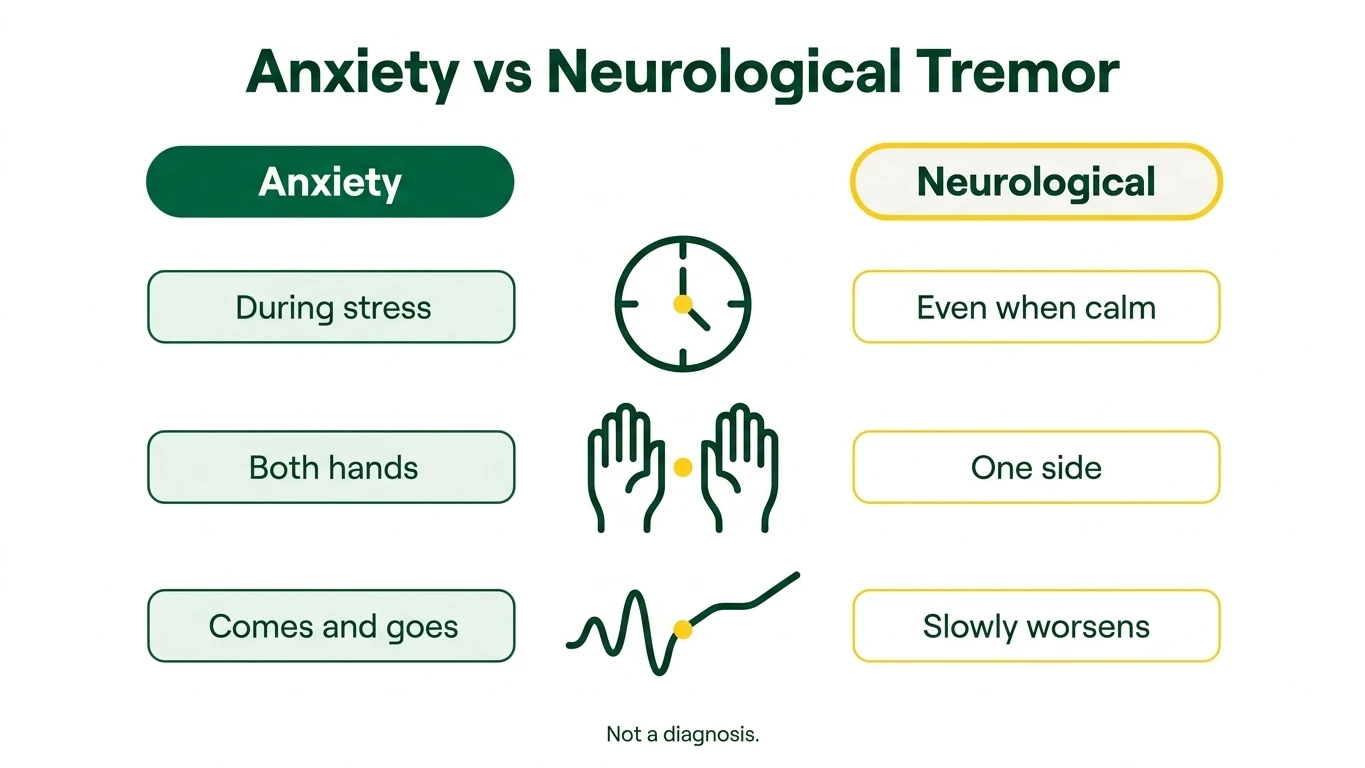
An anxiety tremor usually comes and goes with stress, affects both hands, and fades when you calm down. A neurological tremor follows its own pattern, such as shaking at rest, on 1 side, or slowly worsening over months.
| Clue | Points to Anxiety | Points to a Neurological Cause |
| When it happens | During worry, panic, or stress | Even when you feel calm |
| Where it shows up | Both hands, fine and fast | 1 hand or 1 side, or your head or voice |
| At rest vs. in use | When you hold your hands out or use them | Strongest while your hand rests in your lap |
| Over time | Comes and goes | Slowly gets worse over weeks or months |
| Other symptoms | Racing heart, sweating, fear | Stiffness, slowness, balance problems, or changes in thinking |
A 2018 review in American Family Physician notes that tremor linked to anxiety, caffeine, medication, or tiredness usually needs no further testing. A 2020 review in Tremor and Other Hyperkinetic Movements found that rest tremor was present in 58.2% of people with Parkinson’s disease across three large groups. A 2021 worldwide review in the same journal found that essential tremor affects about 1.3% of people overall and close to 6% of people over 65. It usually shakes both hands during movement.
Which Coping Strategy Fits Your Situation?
Pick 1 technique for public settings and 1 for home, then practice both this week.
| Technique | Time It Takes | Works in Public? | Best For |
| Cyclic sighing | 1 to 5 minutes | Yes | Fast breathing |
| Progressive muscle relaxation (quick) | 2 to 3 minutes | Mostly | Tight shoulders and fists |
| Cold water on your face | About 30 seconds | No | A racing heart |
| Resting your arms | A few seconds | Yes | Visible hand tremor |
| Brisk walk | 5 to 10 minutes | Sometimes | Shaking after an argument |
| 5-4-3-2-1 grounding | 1 to 2 minutes | Yes | Racing thoughts |
How to Stop Shaking When Nervous About Public Speaking
Performance anxiety, the fear that people will judge you while you speak, often shows up in your hands and voice. Skip extra coffee that morning. About 5 minutes before you go on, use a public-ready technique from the table somewhere quiet. Rest your notes on the podium instead of holding them up, and speak your first sentence slowly. A steady start sets the pace for the rest.
Rehearse out loud at home so the words feel familiar when your body feels nervous. If performance anxiety keeps you from presentations or interviews, a professional can help.
A Calming Bedtime Routine for Nighttime Anxiety
Put your phone across the room 30 minutes before bed. Once you lie down, try full-body progressive muscle relaxation, working from your feet up to your face for 10 to 15 minutes. Keep the same bedtime and wake time, even on weekends. Want help with trembling that keeps coming back? Our team can help you find out why, in person or online.
How Long Do Anxiety Shakes Last?
Anxiety shakes usually last as long as the anxiety surge behind them. A shaky moment before a meeting may pass in a few minutes. During a panic attack, shaking can last as long as the attack, which ranges from a few minutes to an hour or longer.
What Happens in a Panic Attack
A panic attack is a sudden wave of intense fear, often with no clear danger. NIMH’s panic guide lists trembling among its physical symptoms, along with a racing heart, sweating, chills, trouble breathing, and tingly hands. These symptoms usually pass on their own as the attack ends.
Why Shakiness Can Continue After Anxiety Peaks
Your body does not calm down the second your thoughts do. Your heart rate and breathing need time to return to normal, so leftover shakiness is normal. Sit somewhere quiet and sip water. Next time, use your technique at the first sign of trembling instead of waiting for it to peak.
If shaking keeps coming back, gets worse over time, or makes eating, writing, or dressing hard, see a provider. Knowing how long anxiety lasts can also make each episode less frightening while you wait.
Lifestyle Habits That Can Worsen Anxiety Shaking
Caffeine, short sleep, skipped meals, and alcohol can make anxiety shaking worse, because they stress the same system anxiety does. Cutting them is part of how to stop shaking from anxiety, though it won’t fix anxiety alone.
Caffeine: A common tremor trigger. If shaking worsens after your second cup, cut your usual amount in half for 1 week.
Sleep: Tiredness strengthens tremor. Aim for at least 7 hours, the CDC’s minimum for adults ages 18 to 60.
Meals: Low blood sugar can cause tremor. If shaking comes with hunger and sweating, eat something and tell your doctor.
Alcohol: Withdrawal can cause tremor, so morning-after shaking may not be anxiety alone.
Medicines: Some antidepressants, asthma inhalers, and stimulants list tremor as a side effect. Tell your prescriber if shaking began after a new medicine or dose change.
Pair these habits with other practical strategies for managing anxiety.
Therapy Options That Help Reduce Anxiety Shaking
Therapy can make shaking episodes less frequent by changing how you respond to the body sensations that trigger them. Cognitive behavioral therapy (CBT) has the strongest evidence, including a technique built around feared body sensations. Self-help covers a lot, but when the shaking keeps returning, therapy works on the pattern behind it.
Cognitive Behavioral Therapy for Physical Anxiety Symptoms
CBT is a talk therapy that changes the thoughts and habits that keep anxiety going. CBT teaches new ways to react to the physical feelings of a panic attack, and that attacks can become less frequent.
A 2018 review in Depression and Anxiety pooled 41 trials with 2,835 patients that compared CBT with a placebo. CBT reduced anxiety symptoms by a moderate amount. The benefit was smaller for panic disorder, and CBT built mostly on exposure showed the largest effects.
Interoceptive Exposure Therapy for Panic Sensations
Interoceptive exposure is a CBT technique where you practice feeling the body sensations you fear, in a safe and controlled way. With a therapist, you might bring on a faster heartbeat or shaky muscles on purpose, then stay with the feeling until it passes. Over time, the sensations become less alarming.
A 2018 review in Psychological Medicine of 72 studies with 4,064 people linked interoceptive exposure to better results and better acceptance. It also found that face-to-face therapy worked better than other formats. A therapist sets the pace and keeps this practice safe, so do not try it alone.
How Psychiatric Support Helps When Tremors Keep Returning
Psychiatric support helps when shaking keeps returning despite self-help and therapy. A provider looks at the full picture, then builds a plan that can include medication, therapy, or both. Healthy habits help but cannot replace treatment for panic disorder.
A Full Psychiatric Evaluation to Rule Out Other Causes
A good evaluation looks beyond anxiety. A provider may do a physical exam to make sure an unrelated physical problem is not causing your symptoms. That matters because an overactive thyroid and other medical problems can cause tremor too.
At Placid Psychiatry’s Fullerton office, the evaluation covers your symptoms, medical history, current medications, and daily routine together. If anxiety is the driver, treatment can include therapy, medication management, or both.
Medication Management When It Fits Your Needs
Medication can help when anxiety disrupts daily life, though not everyone needs it. NIMH lists SSRIs and SNRIs (antidepressants), beta-blockers, and benzodiazepines among the options for panic disorder.
Beta-blockers can help control physical symptoms like a rapid heart rate, sweating, and tremors, though providers do not commonly prescribe them for panic disorder. SSRIs and SNRIs can take several weeks to start working. Benzodiazepines act quickly, but some people develop tolerance or dependence, so providers usually prescribe them for short periods. Only your prescriber can decide which option fits, so never start or stop a medication on your own.
Ongoing Follow-Up to Adjust Your Treatment Plan
Finding the right plan can take some trial and error, and both therapy and medication take time to work. Regular visits let your provider track your symptoms, adjust a dose, or add therapy if the shaking has not eased.
Bring a simple log of when the shaking happened, what you had to eat or drink, and how long it lasted. Many people delay care because they miss the signs they need support, such as skipping work or social plans because of the shaking.
Symptoms That Need Emergency Care
Call 911 or go to the nearest emergency room if shaking comes with chest pain or pressure, trouble breathing, fainting, or sudden confusion. Also go if you have sudden weakness, numbness, or drooping on 1 side of your body, or trouble speaking. These signs can point to a heart problem or a stroke. Get care first and think about anxiety later.
Ready to Get Help for Your Anxiety Symptoms?
Self-help techniques can ease a single shaky episode. But if trembling keeps showing up at work, in social settings, or at night, it may be time for professional care.
At Placid Psychiatry, we provide anxiety treatment that starts with a careful evaluation and can include therapy and medication management. Jaehyun Cho, a board-certified PA-C with a Certificate of Added Qualifications in Psychiatry and more than 10 years of experience, leads your care. To find out why you shake and what can help, schedule your consultation today.
Our office is in Fullerton, and we also see clients from Anaheim, Brea, and Placentia. Online visits are available across California, and we accept many major insurance plans.
Conclusion
Shaking does not mean your body is failing. It means your stress response is working too loudly. The lesson is simple: calm the response, and the shaking calms with it. How to stop shaking from anxiety comes down to three habits. Use a breathing or relaxation technique at the first sign of trembling. Cut back on caffeine and short sleep. Get checked if you notice any red flags.
You do not have to handle it alone. If the trembling keeps coming back, schedule an appointment, and we will help you find out why.
Frequently Asked Questions
Is Trembling From Anxiety Dangerous?
No, anxiety trembling is usually harmless, and panic attacks are not life-threatening. Get checked if the shaking comes with weakness or numbness, or if it does not match the anxiety pattern in the comparison table above.
Can Anxiety Cause Uncontrollable Full-Body Shaking?
Yes. During a panic attack, trembling can spread from your hands to your whole body and feel impossible to control. Start with the 2-minute plan above.
Can Stress Alone Trigger Tremors?
Yes, stress alone can cause visible trembling, even without an anxiety disorder, and it usually fades once the stressful moment passes. If it lingers for days, tell your doctor.
Does Treatment Make the Shaking Stop Completely?
Not always, and no one can promise that. Treatment aims for fewer and milder episodes, and many people find the shaking stops feeling scary even when it shows up.
Should You See a Primary Care Doctor or Psychiatric Provider First?
Start with a primary care doctor if the shaking is new, constant, or comes with other physical symptoms. If those checks come back normal and anxiety seems to drive the shaking, a psychiatric provider can help next.