
1 year or less is how long it takes most people to recover from depression. In a 1994 Archives of General Psychiatry study by Coryell and colleagues, 40% of depressive episodes ended within 3 months, 60% within 6 months, and 80% within 1 year. The other 20% lasted longer. Your own timeline depends on the type of depression, other health conditions, and how soon you start treatment.
How Long Does a Typical Depression Recovery Take?
Most depressive episodes end within 3 months to 1 year. About 40% lift within three months and roughly 80% within a year, though your own timeline depends on the type of depression, your health, and the care you receive. A 1994 Archives of General Psychiatry study by Coryel and colleagues followed 605 patients and more than 800 nonclinical participants for 6 years. The researchers found that recovery timing was remarkably uniform across research centers, patient groups, and first or second episodes.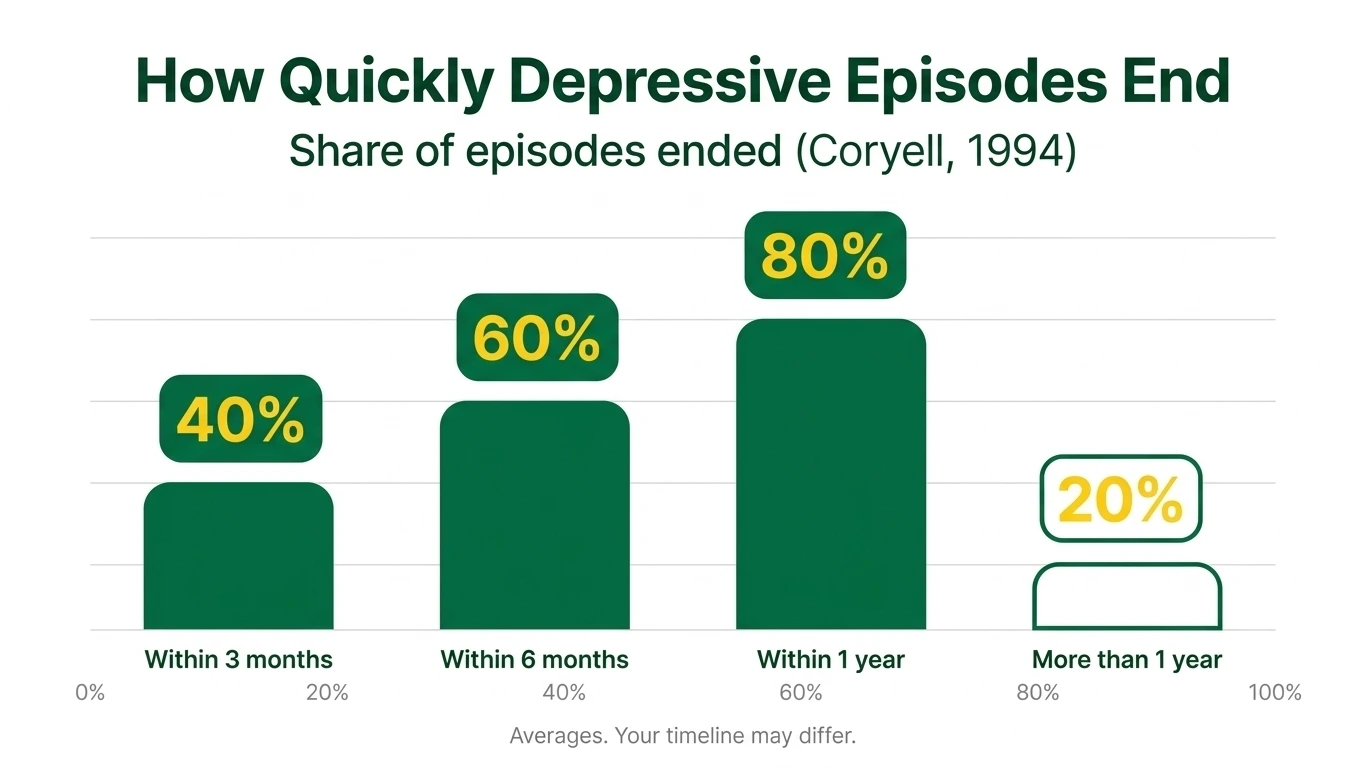
How Quickly Depressive Episodes End
| Time Frame | Share of Episodes That Ended |
| Within 3 months | 40% |
| Within 6 months | 60% |
| Within 1 year | 80% |
| More than 1 year | 20% |
These numbers are averages. If you are in week eight and still struggling, that does not mean you are failing. You may simply be in the stretch where recovery is still ahead of you.
The same study found that the chance of recovery changes over time in a predictable way once an episode begins. That insight matters in practice, because it helps clinicians judge when a treatment has had a fair chance and when it may be time to try something different.
How Long Do Different Types of Depression Last?
How long depression lasts depends on the type. Major depressive disorder needs at least 2 weeks of symptoms, most of the day and nearly every day, under NICE criteria. Persistent depressive disorder needs symptoms for 2 years or more, according to the National Institute of Mental Health. A psychiatric evaluation confirms which type you have, because the type changes the treatment plan.
| Type of Depression | How Long It Usually Lasts |
| Major depressive episode | Often 3 months to 1 year |
| Persistent depressive disorder | 2 years or more, with milder symptoms |
| Seasonal affective disorder | About 4 to 5 months each year, returning with the season |
| Situational depression (adjustment disorder) | No more than 6 months after the stressor ends |
| Postpartum depression | Months to years, and it can pass the 1-year mark without treatment |
The type matters because each one follows a different pattern. Seasonal depression comes back on a schedule, so you can plan ahead for it. Situational depression is tied to a specific event, such as a job loss or a death, and eases as the stress eases. If the stressor keeps going, symptoms can last longer than 6 months.
Postpartum depression is less predictable. Without treatment it can continue well past the first year, which is why early help matters.
Note when your symptoms started and how long they have lasted, then share that with your provider. Duration is one of the main things providers use to tell these types apart.
What Is the Difference Between Response, Remission, and Recovery?
Response means symptoms drop by about 50% (Kennedy, 2002). Remission means you have few or no symptoms. Recovery means remission that lasts for months, not days. Response means symptoms improve by about half or more, but some remain. Remission means symptoms are minimal or gone. Recovery means remission that holds for a sustained period, often eight weeks or longer.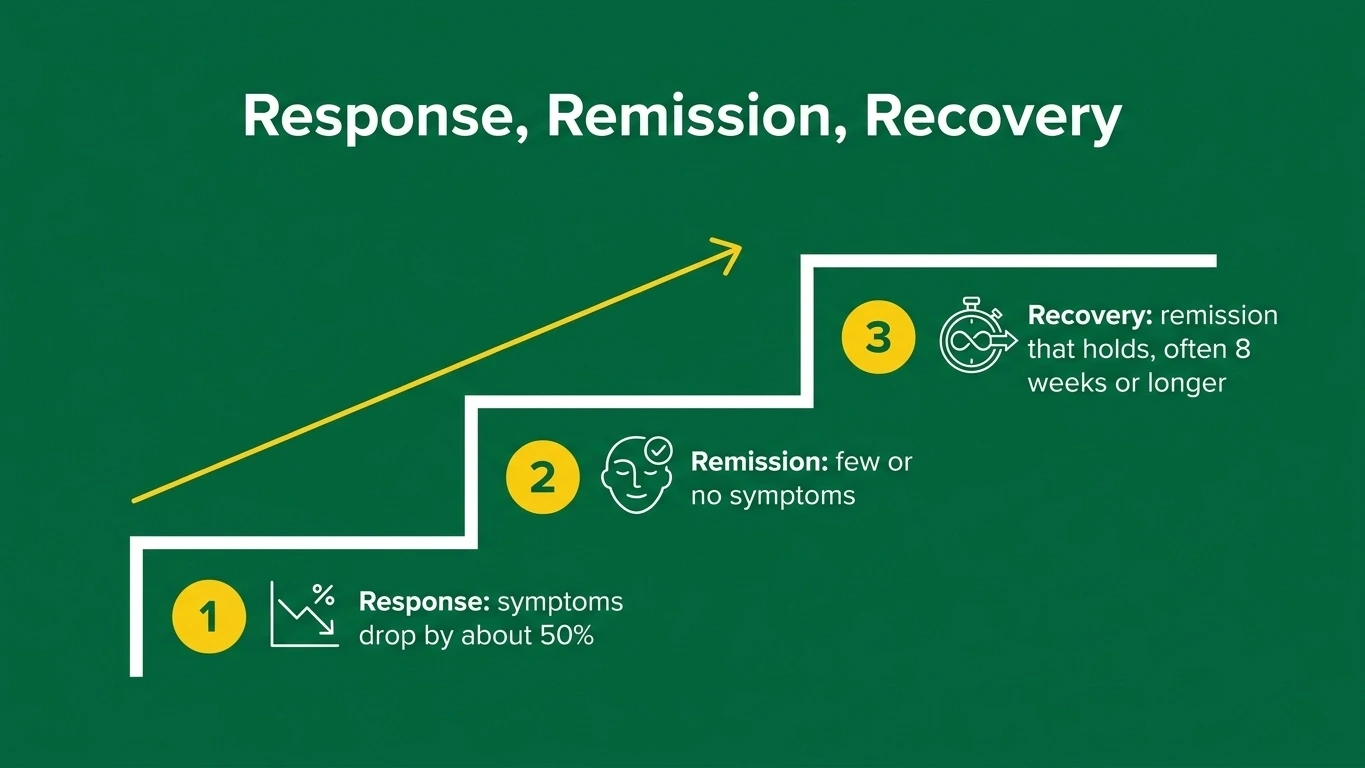
Recovery also involves more than a lower symptom score. People can still struggle with work, relationships, and motivation even when their mood has improved. This is why someone may look fine to others while still needing support.
How Long Does Treatment Take to Work?
4 to 6 weeks is how long most antidepressants take before people notice a difference, according to Mental Health America. First changes from weekly talk therapy often show up after 6 to 8 sessions.
Typical Timelines by Treatment Type
| Treatment | When Benefits Often Begin | Source |
| Antidepressant medicine | 4 to 6 weeks to notice a difference | Mental Health America |
| Psychotherapy | First changes after 6 to 8 weekly sessions; full course 12 to 20 weeks | Talkspace, 2025 |
| Lifestyle changes | Gradual gains over weeks to months | Post |
At Placid Psychiatry in Fullerton, CA, depression treatment starts with a psychiatric evaluation and a plan that is reviewed as you improve.
How Do You Know If a Treatment Has Had a Fair Chance?

Give an antidepressant at least 4 to 6 weeks before you judge it, because most people notice a difference in that window (Mental Health America). If little has changed by then, your provider may raise the dose; the NHS notes a fluoxetine dose may be raised after 3 to 4 weeks. Take every dose, attend every session, and track your sleep, energy, and mood each week. Call sooner if symptoms get worse.
What Can Slow Down Recovery?
6 factors most often slow recovery from depression and can stretch your depression recovery time from months to more than a year:
- Untreated or delayed care
- Other conditions, such as anxiety, substance use, chronic pain, or thyroid problems
- Ongoing stress and isolation
- Poor sleep
- Stopping medicine as soon as you feel a little better
- A low dose or a treatment that does not fit
A thorough psychiatric evaluation can uncover these hidden obstacles so your plan addresses the whole picture. It also helps to remember that none of these factors reflect personal weakness. Depression is a medical condition, and the things that prolong it are usually circumstances, not character flaws. Tell your provider about each one so your plan can address it.
What Can You Do at Home to Support Recovery?
Five daily habits support depression recovery alongside treatment: regular sleep, daily movement, limiting alcohol and drugs, social contact, and a simple routine. They do not replace medicine or therapy, but they help treatment work better, with gradual gains over weeks to months.
- Regular sleep: Keep the same bedtime and wake time each day, because poor sleep feeds depression.
- Daily movement: Walk for 10 minutes and add time slowly.
- Limit alcohol and drugs: Substance use can keep depression going, so limit it.
- Social contact: Call a friend or share a meal, because isolation makes healing harder.
- A simple routine: Plan 1 to 3 small tasks each day, such as cooking or returning a call.
Start with one habit, not all five. If you cannot sleep, eat, or care for yourself, contact your provider. Tell your provider which habits you are trying so your plan can be adjusted.
How Do You Know You Are Recovering From Depression?
You are recovering from depression when sleep, appetite, and daily tasks improve before your mood fully lifts, often weeks before you feel like yourself. It shows up in small, ordinary changes. You may notice that you sleep better, your hunger returns, and mornings feel less heavy. Tasks you avoided start to feel doable. You laugh at something without forcing it. Other people may notice before you do.
Pay attention to daily functioning as well as mood. Answering emails, cooking a meal, returning a friend’s call, or finishing a work task without dread are all meaningful signs that your life is coming back into balance, even if you do not yet feel completely like yourself.
Setbacks Are Normal
Good days and bad days will mix for a while. A rough week does not erase your progress. Recovery usually moves up and down for weeks before it settles. If a setback lasts more than a couple of weeks or feels like a slide back to where you started, tell your provider so your plan can be adjusted early.
What if Depression Lasts Longer Than a Year?
If depression lasts longer than 1 year, it is time to recheck the diagnosis and change the plan. About 20% of episodes run past 1 year (Coryell, 1994), and long episodes still often end: in a 1996 study by Mueller and colleagues, 93% of patients had recovered by year 10.
How Is Depression Diagnosed?
A provider diagnoses depression through a psychiatric evaluation. The provider reviews your symptoms, history, current medicines, and other health conditions, such as thyroid problems. Major depressive disorder requires symptoms most of the day, nearly every day, for at least 2 weeks. Persistent depressive disorder requires symptoms for at least 2 years in adults.
Major Depression vs Persistent Depressive Disorder
Major depressive disorder is diagnosed when symptoms last at least 2 weeks and interfere with daily life. Persistent depressive disorder is different. Its symptoms are often milder but last 2 years or more in adults. Because the two conditions can overlap, an accurate diagnosis matters for choosing the right treatment.
Can People Recover After Years of Depression?
Yes, and the research is hopeful. A 1996 Archives of General Psychiatry study by Mueller and colleagues followed 431 patients with major depression for 10 years. Among the 35 who were continuously ill for the first five years, 38% recovered within the next five. By year ten, an estimated 93% of the full group had recovered from their original episode. The authors also noted that treatment in the study was often at a low level despite the long illness, which suggests many people were never offered stronger care.
What Is Treatment-Resistant Depression?
Depression is generally called treatment-resistant when symptoms have not improved after trying at least two different antidepressants for a long enough time. It is more common than many people realize, and it does not mean you are out of options.
Which Treatments Can Help When Medicine Is Not Enough?
TMS, Spravato, a medicine switch or added medicine, and structured therapy can all help when 2 antidepressants have not worked. Transcranial magnetic stimulation is an FDA-cleared, drug-free treatment that sends magnetic pulses to mood-related brain areas. Common side effects are mild, such as headache or scalp discomfort, and you can drive yourself home after a session.
Spravato (esketamine) is a nasal spray the FDA approved in March 2019 for adults with treatment-resistant depression. It is used with an oral antidepressant, taken in a certified clinic, and followed by at least 2 hours of monitoring. Spravato treatment can work faster than traditional antidepressants for some patients. Your provider can explain which option best fits your history.
Researchers are studying new approaches as well. In a 2020 JAMA Psychiatry trial led by Alan K. Davis at Johns Hopkins, 24 adults with major depression received two doses of psilocybin alongside supportive psychotherapy, and about half were in remission four weeks later. The study was small, and psilocybin is not available as a treatment, so it remains an area of research.
Will Depression Come Back After Recovery?
Yes, for about half of people. Optum and Nurx both report that about 50% of people who recover from a depressive episode have another one. A 1997 10-year follow-up by Solomon and colleagues tracked 258 people with unipolar major depression through multiple episodes. Recurrent episodes lasted a median of about 20 weeks, and the length stayed remarkably consistent from one episode to the next. Importantly, patients kept recovering each time. Staying on your plan, keeping regular sleep and activity habits, and attending follow-up visits all lower the chance of a relapse turning into a long episode.
How Long Should You Stay on Treatment After You Feel Better?
Usually several months or longer after you feel better. The NHS says most people keep taking an antidepressant for several months after they feel better, and Nurx reports providers often suggest at least 6 to 9 months after symptoms improve.
- Stop only with your provider’s help, because stopping suddenly can cause withdrawal symptoms (NHS).
- Your provider will usually lower the dose slowly over several weeks or months (NHS).
- Keep follow-up visits, even when you feel well.
Does Depression Ever Go Away Permanently?
Yes, for some people 1 episode is the only one they have, but about half of people have another episode. For those who do have another episode, depression is closer to a long-term condition that comes and goes, with long stretches of good health in between. Either way, recovery is real and lasting wellness is within reach. Learning your early warning signs helps you act quickly if symptoms return.
Can Depression Go Away on Its Own?
Yes, mild depression sometimes eases without treatment, but untreated major depressive episodes often last 6 to 12 months (Optum; Nurx). Untreated depression can deepen, strain relationships and work, and raise the chance of future episodes. Getting help does not mean you cannot recover on your own. It means you do not have to spend months suffering while you wait to find out.
Early support also protects your daily life in the meantime. Sleep, concentration, and relationships tend to hold up better when treatment begins sooner, and that can shorten recovery.
When Should You Get Help Right Away?
Do not wait if you notice thoughts of suicide or self-harm, or feel that others would be better off without you. The same goes for being unable to eat, sleep, work, or safely care for yourself or others, hearing or seeing things that are not there, using alcohol or drugs to cope with feelings, or symptoms that are steadily getting worse instead of better.
If you are in immediate danger, call 911. In the United States, you can also call or text 988 to reach the 988 Suicide & Crisis Lifeline at any hour.
Talk to a Care Team About Your Depression
You do not have to plan your recovery alone. At Placid Psychiatry, your first visit is a full psychiatric evaluation. Your psychiatrist reviews your symptoms, past treatments, sleep, and other health conditions that can slow recovery. Then your psychiatrist builds a depression treatment plan and sets a date to check whether it is working. Visits are in person in Fullerton or by telehealth. If 2 antidepressants have not helped, you can ask whether TMS or Spravato fits your case. Contact us to schedule your appointment.
Conclusion
How long it takes to recover from depression varies, but most episodes improve within 1 year. Most episodes improve within a year, many people recover even after years of illness, and new treatments keep expanding the options. The best step is the next one: get an accurate diagnosis, follow a plan that fits you, and stay connected to support. Recovery takes time, but it is far more common than depression makes it seem. Measure progress in small steps; remember that asking for help is one of the strongest moves you can make.
Frequently Asked Questions
How long does a depressive episode usually last?
1 year or less for most people. In the 1994 Coryell study, 40% of episodes ended within 3 months and 80% within 1 year.
How long do symptoms need to last for a diagnosis?
2 weeks for major depressive disorder, with symptoms most of the day, nearly every day, under NICE criteria. Persistent depressive disorder needs symptoms for 2 years or more, according to the National Institute of Mental Health.
How long does treatment take to help?
4 to 6 weeks for most antidepressants, according to Mental Health America, and 6 to 8 weekly sessions for first changes from talk therapy.
Can depression come back after I feel better?
Yes. About half of people who recover from a depressive episode have another one, according to Optum and Nurx. Continued treatment, healthy routines, and quick action on early warning signs make relapses easier to manage.
What if my first treatment does not work?
If a treatment has not helped after enough time, your provider can change the dose, switch the medicine, add a second one, or add structured therapy. Needing a new plan is a normal part of treatment, not a sign that nothing will work.